

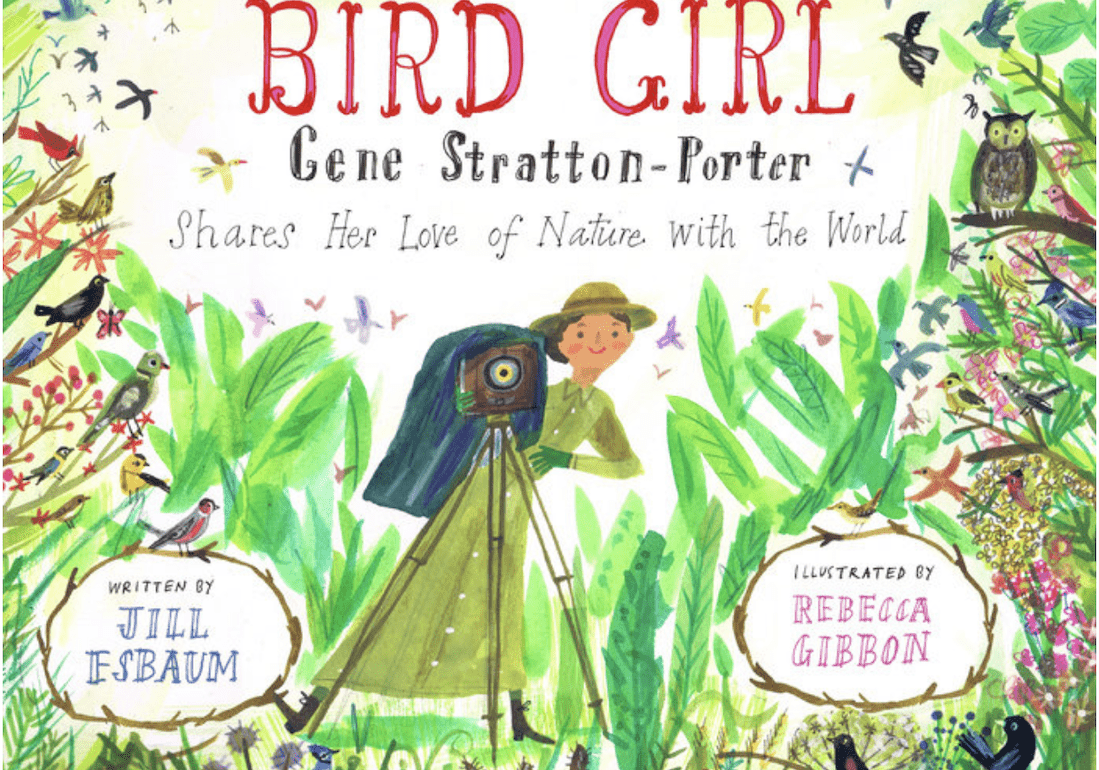
For two weeks straight, Gene Stratton-Porter sloshed through hip-deep water carrying a 40-lb camera to get the perfect picture of a nesting rail.
As you whip out your camera or cell phone, think of Gene. As a novelist, she was best known for her nature-filled books like A Girl of the Limberlost and The Keeper of the Bees, but a new picture book for children reinserts her into her rightful place in history—as one of the world’s first bird photographers.
For author Jill Esbaum, her book Bird Girl: Gene Stratton-Porter Shares Her Love of Nature with the World started with re-reading Gene’s novel Girl of the Limberlost. Research on Gene’s life led Jill straight down a rabbit hole into the extraordinary. According to Jill, Gene was “feisty and opinionated and determined to master everything she tried… [I] thought kids might enjoy reading about how she worked for five years teaching herself bird photography.”
Those five years began in 1895, when Gene was given a camera for Christmas. Her first photo was of her parrot, Major. With that picture—although blurred and streaky—Gene understood that the camera was exactly the tool she needed. Editors had wanted to pair her articles for nature magazines with illustrations of taxidermied animals that looked nothing like the birds she saw outdoors. Photos were the answer. They would enable Gene to share the birds she loved with the world.
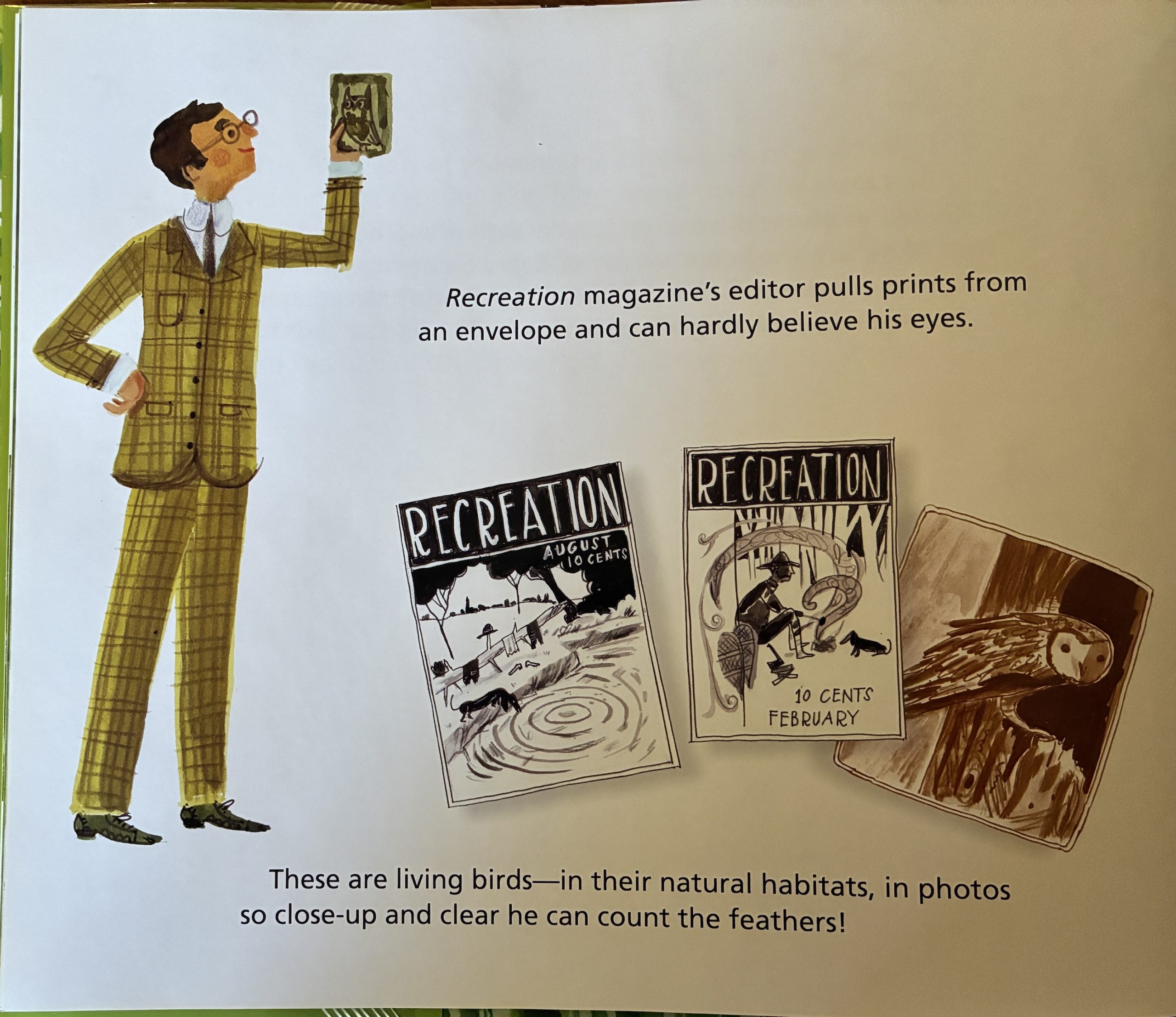
Gene set out to teach herself to become a nature photographer. There was nothing she wouldn’t do for a great shot. As Bird Girl notes “She fights through spongy muck and tangled undergrowth—rattlesnake territory—to reach the hollow tree where a vulture nests. She goes back time and again to capture the world’s first photo series of a growing vulture chick.”
Bird Girl introduces Geneva to readers when she was a child, growing up in Indiana in the 1800s, carry for the chickens and watching birds. When her father shot for being too close to the chickens, Geneva nursed it back to health. After that, any injured birds were taken straight to her. Some she nursed back to health. Others, too injured to fly, were kept in cages at her home. By the time she was an adult, she had special windows built in her conservatory so that birds could fly in and out as they chose.
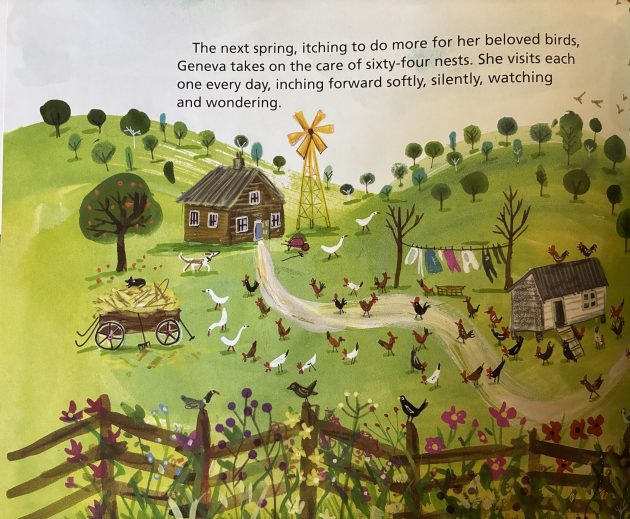
Welsh-born artist Rebecca Gibbon’s illustrations immerse readers directly into Gene’s world, a world centered on birds. From sun-drenched fields to murky swamps, there are birds on the ground, in the sky, in her hands. In her years of capturing birds on film, Gene not only became a bird photographer, but she also became an expert on bird behavior.
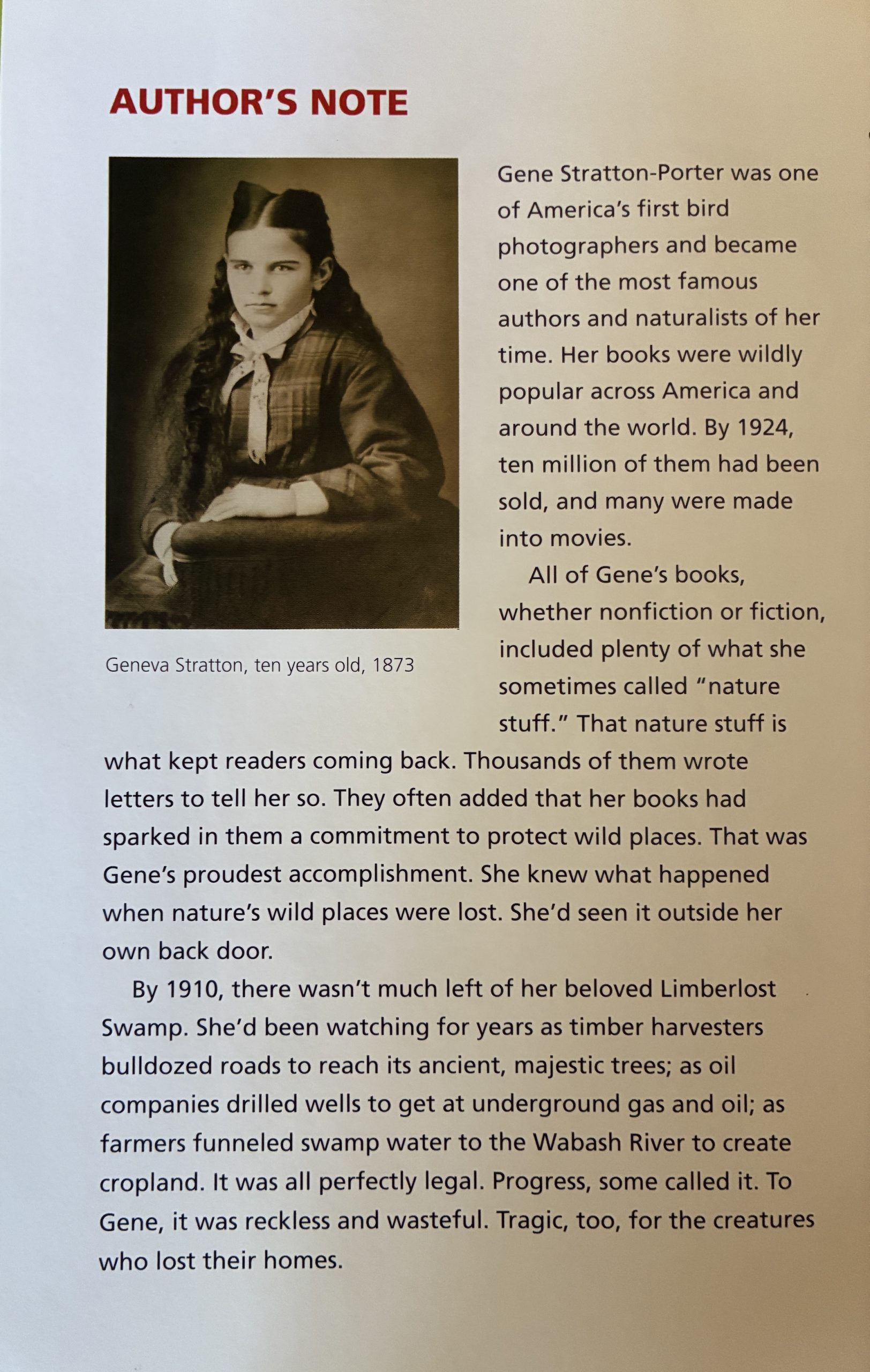
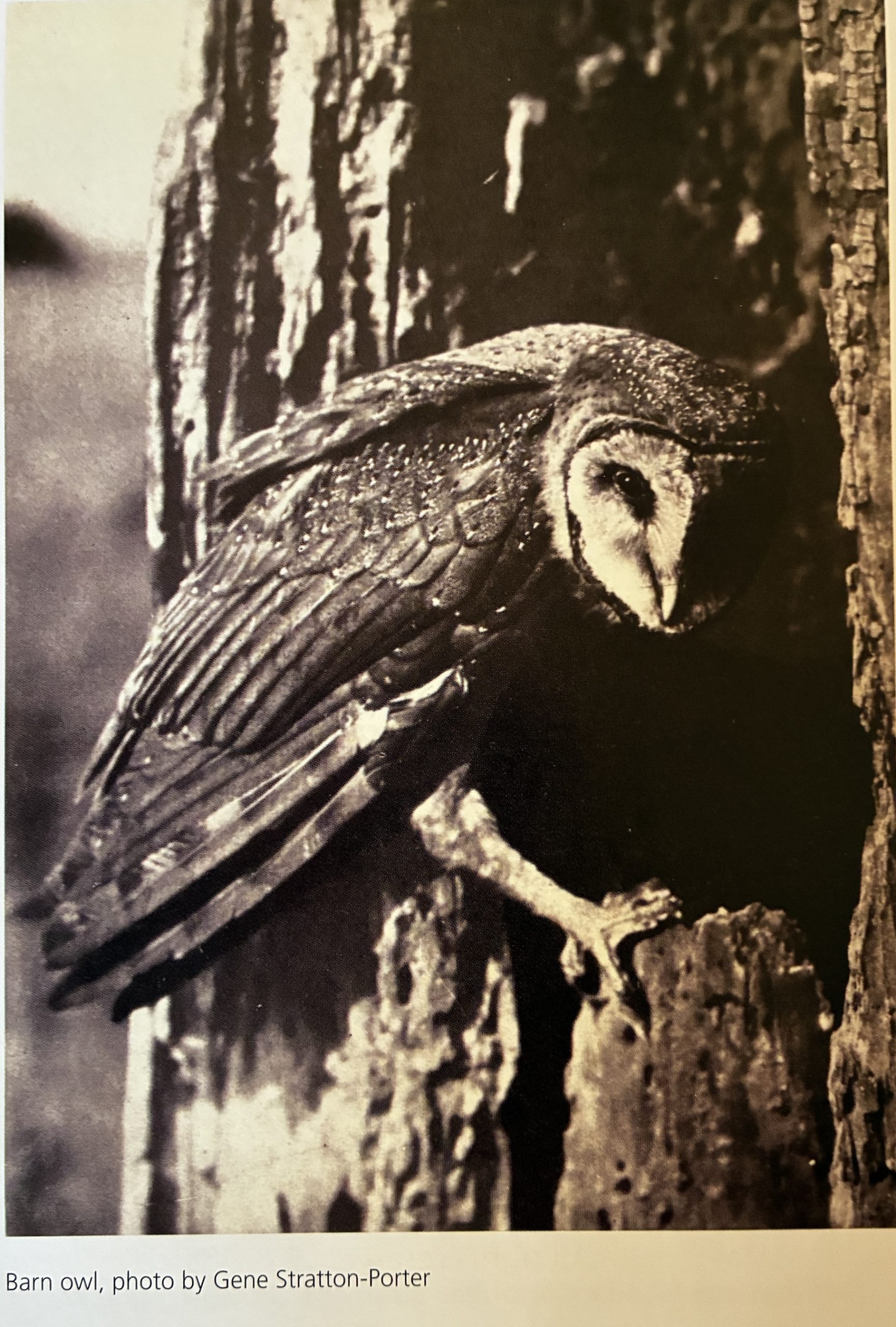
Librarians say that backmatter with photographs helps young readers understand that a story is true, and Bird Girl delivers. There’s a photo of Geneva at age 10 in 1873, another 51 years later, and one of a Barn owl—one of Gene’s own photographs. The bibliography is divided by primary and secondary sources, and there is a selected list of Gene’s works in both fiction and of nature studies.
By 1910, the Limberlost Swamp of Indiana, where Gene spent so much of her time, was largely destroyed by loggers removing the trees, oil companies drilling, and farms diverting the water for agriculture. Now, a century later, organizations inspired by Gene’s legacy have begun buying patches of the swamp with the intention of bringing it back—and thus far, they have saved nearly 2000 acres.
For this generation of children, who are further removed from the natural world than at any time in history, Bird Girl carries a message of finding in nature wonder and hope, possibility and happiness—and that is something all of us can use.
Bird Girl: Gene Stratton-Porter Shares Her Love of Nature with the World, written by Jill Esbaum and illustrated by Rebecca Gibbon
Calkins Creek, 2024
ISBN: 978-1-63592-686-6
48 pages, age 7-10
US $18.99





Leave a Comment