

I saw the movie Hamnet at the end of last week on its opening day in the United States. In 2022 or 23, I read the novel Hamnet and was unable to put it down. Hamnet’s subtitle is A Novel of the Plague and it is that, although somewhat less so with the movie. The novel and movie are named for the twin son of William Shakespeare and Agnes (Anne) Hathaway, who died from the plague or Black Death in 1596 at age 11.
In the historical novel by Maggie O’Farrell, William first sees Agnes from an attic window of a classroom where he is tutoring three boys. For a moment, the tutor believes it to be a young man. He is wearing a cap, a leather jerkin, gauntlets; he moves out of the trees with a brand of masculine insouciance or entitlement, covering the ground with booted strides. There is some kind of bird on his outstretched fist: chestnut-brown with a creamy white breast, its wings spotted with black. It sits hunched, subdued, its body swaying with the movement of its companion, its familiar (p. 19). As the “hawk-taming youth” (p. 20), comes into full view he sees that the person he has been watching is a young woman. William is either smitten, or just curious, and after leaving his students he finds Agnes to speak with her and see her bird. The bird is alternately described as a hawk and a falcon.
The movie Hamnet opens with the young woman napping in the roots of a gigantic tree. (The movie was shot on location in Herefordshire, England.) She is awakened by a change in the wind, or possibly something else. She rises and inserts her right hand and arm into a falconers glove. She whistles and a hawk flies down to land on her arm. With close-up framing, she speaks to the bird as she feeds it and acknowledges that it’s hungry.
The bird that flies down and lands on Agnes’s arm is a Harris’s Hawk (Parabuteo unicinctus). Now I admit that I was in the theater to see a movie about William Shakespeare (Paul Mescal), his wife Agnes (Jessie Buckley) and their three children and, as any movie lover, I am no stranger to cinematic privilege. I had forgotten all about Agnes’s hawk in the book. I was immediately distracted by the presence of a Harris’s Hawk in England around the year 1580. How could that have been possible? I believe falconry is still a popular hobby in Great Britain. Why not use a Sparrowhawk or a Goshawk for the scene? Both would have been present in England in the late 1500s. Both are birds trained by falconers. Of course, the Harris’s Hawk was beautiful and beautifully trained and commanded an onscreen presence. The scene appeared to be filmed as it actually occurred. If you go to see Hamnet, and I recommend it, don’t be surprised when a Harris’s Hawk joins the scene.
Hamnet, the movie, moves along quickly and I needed to pay attention. But when I was driving home from the theater I began to think of other movies where I was startled by the inappropriate use of birds—mostly vocalizations. One of my favorite movies of all time, The Shawshank Redemption (1997), based on the novella titled Rita Hayworth and Shawshank Redemption by Stephen King (1982), came immediately to mind. You know the line: “Get busy living or get busy dying.” Yeah, that movie.
In the scene where Red, played by Morgan Freeman, and now finally paroled from Shawshank Prison, follows his escaped friend, Andy Dufresne’s, played by Tim Robbins, request to go to a big farm field with a stone wall along the road, and a big oak tree in the middle, where “no oak tree has a right to be”, there will be something there for Red. “I want you to go there and dig it up.” Red remembers Andy’s request, and from his halfway-house room for paroled prisoners, he hitchhikes to the field. There is no one around and no cars on the narrow, two-lane rural road, but after 40 years in prison, Red is alert and cautious. He is startled by the song of a Cactus Wren (Campylorhynchus brunneicapillus). Now, Shawshank Prison is located in the state of Maine. The halfway-house is likely in Portland, Maine. Why is a Cactus Wren singing in a farm field in Maine? True enough, the Cactus Wren’s song is a very good fit for the drama of the scene. Red finds the tin box and rests his back against the stone wall to open it. He hears the Cactus Wren song again and he gives a cautious look around to be sure he is still alone. In the box Andy has left money and a letter saying “by now, if you are reading this, you’re out of prison” and reminds Red with his location hint. The closing scene has Red purchasing a bus ticket to Fort Hancock, Texas where he will cross over into Mexico to find his friend Andy on the beach repairing an old wooden boat. Great, great movie. You will love the singing Cactus Wren in a Maine farm field.
Cold Mountain, the 2003 movie, based on the 1997 historical novel by Charles Frazier with the same title, is a movie I don’t remember quite as well, but there is one scene that I have not forgotten. The story is based in North Carolina during the Civil War, but the movie was shot in Romania because, apparently, this was the most suitable location the filmmaker could find. The main character, Inman (Jude Law), escapes from his infantry and is walking home along a forested, mountain road in a snowstorm to re-unite with his love, Ada Monroe (Nicole Kidman). In the absolute quiet of this endeavor the song of a Red-eyed Vireo (Vireo olivaceus) is suddenly heard. Now, considering that the movie was shot in Romania, why is a Red-eyed Vireo singing? And, during a snowstorm to boot. Wouldn’t this bird have been in Central or South America by the time the snow fell? I don’t think it would have been so difficult to edit in a more suitable bird vocalization for this scene. A Blue Jay, a Red-bellied Woodpecker, a Cardinal … perhaps?
These are the scenes I remembered while I was driving home from the movie. There are, no doubt, countless other examples like this. After I get over my surprise at hearing a Red-eyed Vireo singing in a snowstorm or a Cactus Wren singing in the state of Maine or seeing a Harris’s Hawk in 1580 England, I settle in to enjoy the movie. I’m always grateful to be able to identify such oddities, especially when I know that most viewers (not all!) will never notice.
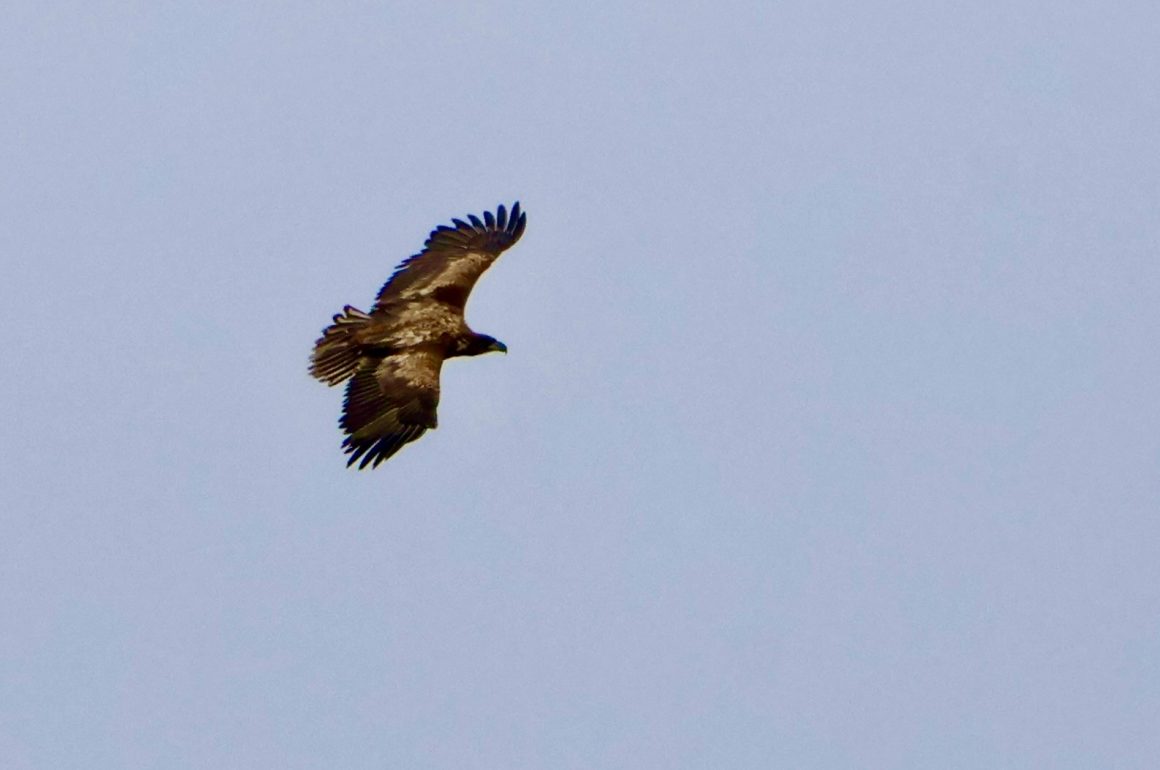
Cover photo: Not exactly the best photo for the post, but at least it’s a soaring raptor. Juvenile White-tailed Eagle taken in Finnmark, Norway in June, 2025.







There weren’t, of course, any Harris’s Hawks in England when Shakespeare was alive. Falconry is still practised in England, with the Goshawk the hawk of choice of those who fly short wings (hawks) and Peregrines favoured by people who fly long wings (falcons). Hybrid falcons are also popular.
Harris’s hawks are kept widely because they are by far the easiest birds to train. They are known as the beginner’s hawk for this reason, and would be much simpler to use as a film prop than a temperamental goshawk.
Many spaghetti westerns feature Griffon Vultures, European birds that you don’t find, of course, in the Wild West. I’ve also heard Nightingales singing in so-called westerns. However, I wonder how many people notice?
So interesting! I’ve watched a few of these movies and it’s something I wouldn’t have picked up either.
The worst offender is in”Mary Poppins” where in Edwardian England the robin portrayed in the song is an American Robin and not the traditional Robin Redbreast .
!
Tarzan has kookaburras, the standard hawk (buzzard for Euros) in Westerns is apparently also the wrong species – although I forgot the details. If you expect historical or biological accuracy from Hollywood movies you’re in for a lot of trouble.
Same here, Sanjana …
Thank you for all of the nice comments and, indeed, other examples, too.
However, I have an error of my own to correct. I received an email from David T this morning with an ID correction. The bird in the cover photo is NOT a Golden Eagle! It is a juvenile White-tailed Eagle ((Haliaeetus albicilla). I responded to David that, as I was writing, I knew I should have checked the ID. Would have been so easy because the trip checklist was on my desk. I was just lazy. Goes to show. As it turned out, Golden Eagle was seen only once on the trip, but I documented on my checklist that I didn’t see it. So, I certainly could not have got a photo. A good reminder of how important it is to be careful—and not just for movie directors. I corrected the ID in my post.
I’m just here to make special mention of the Screaming Piha – the sound of the Hollywood jungle, regardless of where the scene is set! Happy to know that I’m not the only one who sees these things, despite my lack of movie experience.
In movies, tv shows, and in commericials, the call of the Red-tailed Hawk is very often played as a Bald Eagle makes an appearance.. I guess the chirping of the Bald Eagle is not as ‘outdoorsy’ as the Red-tail,
I feel quoting le Comte de Buffon is appropriate whenever the Bald Eagle is mentioned. As shown on this site: feeble!
Hi, late to the party, I am writing from England, a different part of the Midlands where most of the action is set. Thank you for writing on this.
I have just seen the movie and I was impressed in many ways. I thought young Hamnet a very moving performance and a neat touch to use the actor’s elder brother to play Hamlet at the end.
On the birds which is the point of the thread I too was surprised (eye roll) to see a Harris’s hawk used, although as a previous poster remarks it is the so-called beginners bird in modern falconry perhaps I shouldn’t have been so surprised (I am not a falconer, I am an ecologist with moderate birding skills). I have seen these hawks at most displays I have attended so they do give good value.
To correct a misremembered part of the book as reported in the original post (I speed read the book days before the screening so it was fresh) the bird in question is clearly identified as a kestrel p 76 and p79. Agnes corrects Will when he calls it a hawk.
If you are interested in kestrels in film search out Kes (a book and a film)
Another awkward moment was Paul Mescal swimming with a powerful front crawl, a stroke introduced, so I am told, to England by Ojibwe swimmers Flying Gull and Tobacco in 1844 (Wiki Front Crawl history)
But put all that to one side and enjoy the film, then read the book.
I am into history and so slightly resented this invention with so little basis in recorded history, as the book progressed I put that to one side and immersed myself in this version the artist created.
This is a great and multi-layered comment Richie. Thank you for taking the time to write it. I echo all of your comments about the movie. Loved it absolutely.
As the original post writer, I must admit that I don’t recall ever seeing the word Kestrel used in O’Farrell’s novel. I do recall the word falcon, but I did not automatically translate that to a Kestrel. As it happens, Kes the 1969 movie was aired on our commercial-free (yes, there is one in the US) movie channel Turner Classic Movies this morning at 12:15 am. I could not raise myself to watch it at that hour. I did read the book back in the 70s and loved it and at some point I also saw the movie and loved it. No one makes better, rawer working class movies than the Brits. Always amongst my favorites.
Paul Mescal (playing Shakespeare) free style swimming in the movie. It was a beautiful scene, but while watching, I knew there was something odd about it. Now I know.
So great to read this. Being a naturalist and a cinephile it really gets to me when productions are lazy doing their checks. And it is pure laziness – there are tons of folks out there who could help with checking. The Harris’s hawk also vocalizes with a red-tailed hawk call in Hamnet. A hawk with an identity crisis.
One of the other classic mishaps is the hornbill species showing up in scenes set in South America. Come on folks. It’s not that difficult.
Thanks for a fun thread.
No Oscar for the hawk in Hamnet.
A BBC production of Shakespeare’s The Merchant of Venice, some years ago, demonstrated the merchant’s opulent lifestyle with a beautiful garden with Black Swans on the lake.
His fleet must have reached Australia. Some achievement without the Suez Canal.
A Cattle Egret in Central America 5 centuries before they crossed the Atlantic (Apocalypto), then Carrion instead of Hooded Crows at corpses in Stalingrad (Enemy at the Gates)…
I touched the subject in Cry “Havoc!” or a Birding Movie before the Birding Movie (https://www.10000birds.com/cry-havoc-or-a-birding-movie-before-the-birding-movie.htm).
How is it so hard to get the sounds right? There are plenty of people that moviemakers could consult by the sound of it. Another example: in the movie “Quest for Fire”, supposedly set in Africa, there are the sounds of Black-throated Green Warblers and Red-eyed Vireos singing in the woods – at least they used the ambient sounds of where it was filmed (the Niagara Escarpment in Ontario, Canada). And the American Robin in Mary Poppins was just sad.