

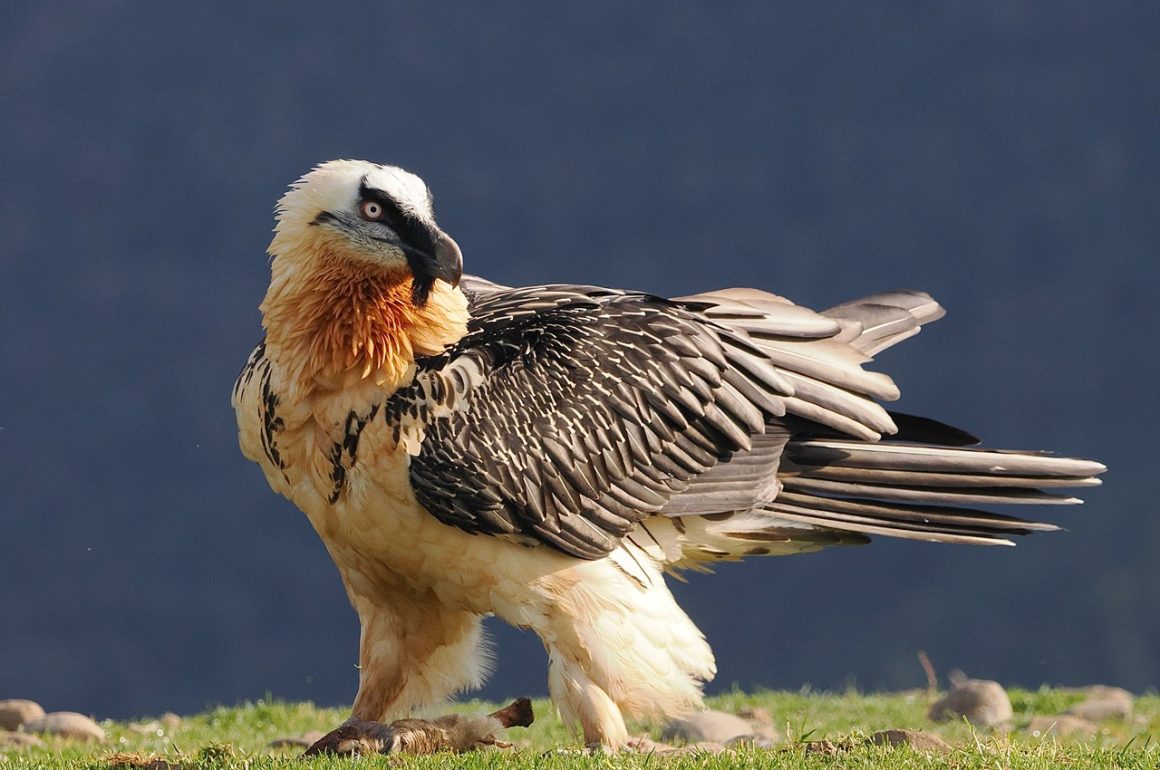
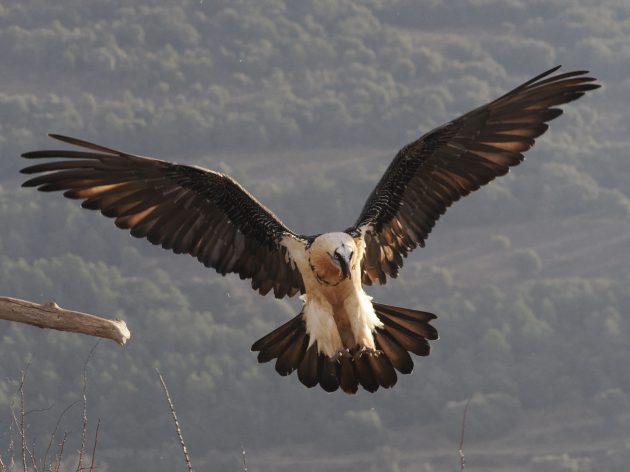
Let’s face it. As a general rule, vultures – and especially the Old World vultures – are not a good-looking lot. They may be impressive when flying, with their huge wing spans and supreme soaring ability, but up close they don’t score so highly. Most have bald heads, serpentine necks and unfriendly eyes, not to mention bad table manners. There is, however, one glamorous exception: the Lammergeier or Bearded Vulture, Gypateus barbatus. It’s a big, handsome bird, with attractive colouring, feathers on its head and even an interesting little beard. It can boast an impressive 10ft wingspan, and has a flight silhouette which recalls a huge falcon, rather than a vulture.
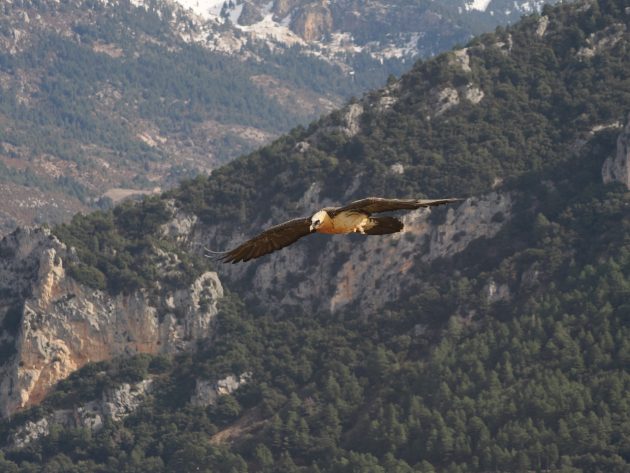
I’ve been lucky enough to have seen Lammergeiers on many occasions in several different countries and on three different continents, for this is a widespread bird. I’ve watched them soaring over the Himalayas in Kazakhstan, the Drakensburg in South Africa, the Caucasus in Georgia and the Pyrenees and Picos de Europa in Spain. They are birds that like high mountains, but in Spain they are also found in the pre-Pyrenean massifs, the impressive range of mountains that rise up before the Pyrenees themselves, and it was here that I had the pleasure of watching them earlier this month.
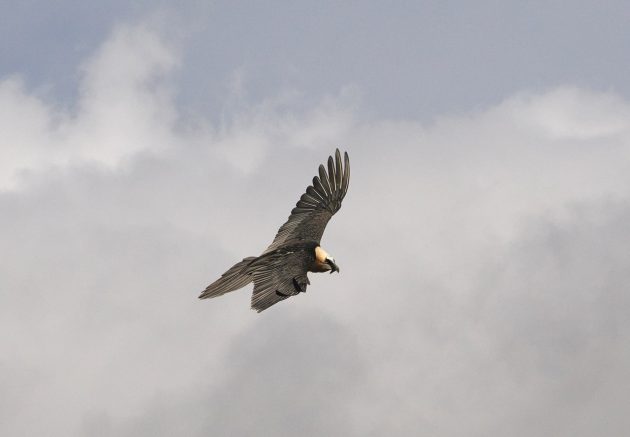
Historically these fascinating birds were once far more widespread in Spain, and until the end of the 19th century they could be found in all of the country’s main mountain ranges. Sadly, relentless persecution reduced the population to a mere 40 pairs by the late 1980s, since when numbers have been rising slowly but steadily, helped by re-introduction projects in the Picos de Europa mountains in the north, and Andalucia in the south.
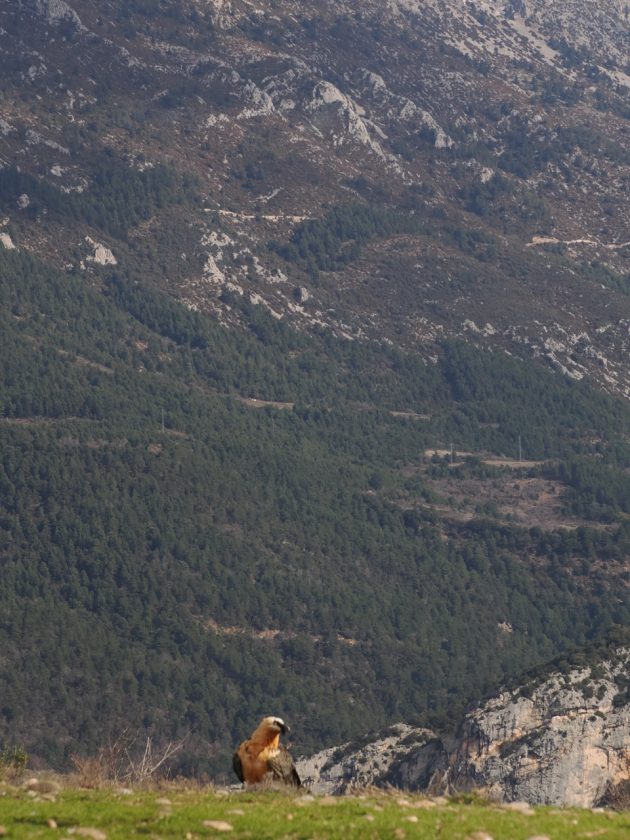
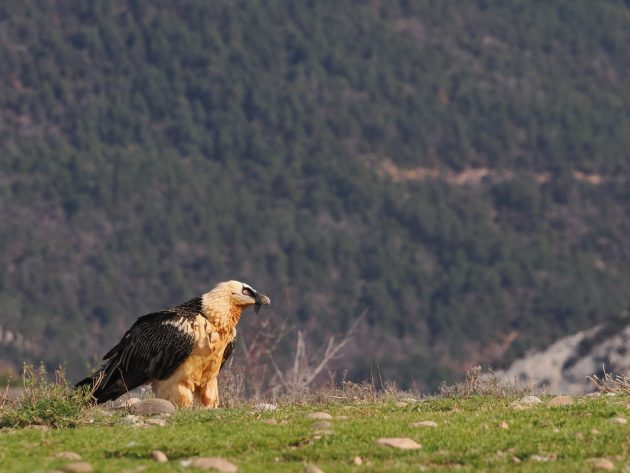
They are slow to mature, not breeding until at least five years of age, while productivity is low, for they never rear more than one chick a year, despite laying two eggs. However, survival rates of juveniles are high. By 2010 the Spanish population had passed 100 pairs; last year there were reckoned to be 151 territories in the Spanish Pyrenees and pre-Pyrenees. According to the Vulture Conservation Federation, the Pyrenees have now reached their maximum carrying capacity.
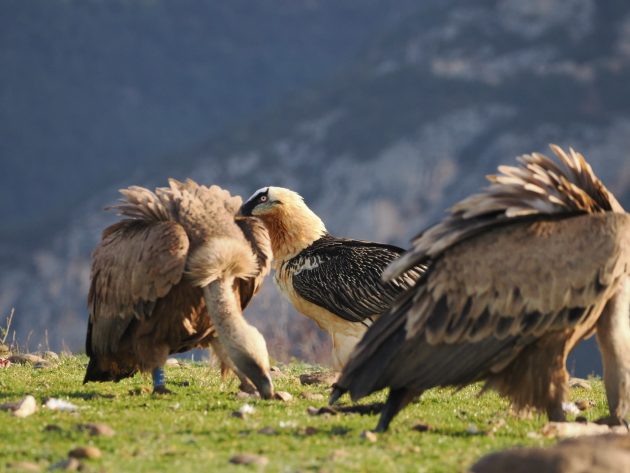
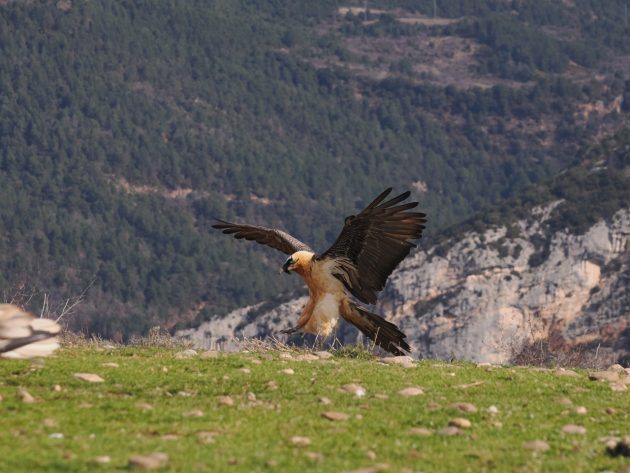
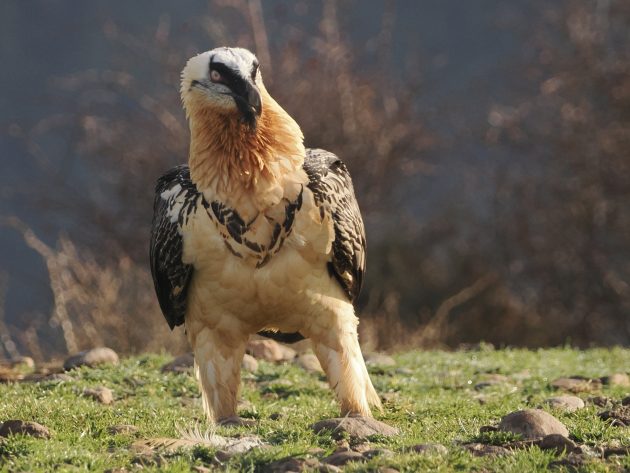
Though I may have seen Lammergeiers many times, most of my sightings have been of distant birds, soaring over far-away peaks. The flight silhouette is so distinctive that this is one bird that you can reliably identify at huge range. My most recent encounter was very different, for the Lammergeier landed just feet away from my hide, so I was able to admire this huge bird at close range.
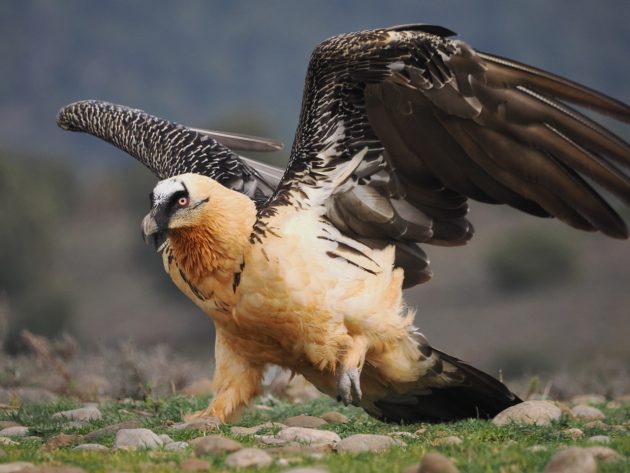
According to the stories I’d heard, Lammergeiers rarely come down to feed until the crowds of Griffons vultures have left, for they are not interested in flesh, but like the bones the Griffons leave behind. So on our first morning in the vulture hide we were in place at 7.45am, but not expecting to see a Lammergeier for several hours. Two o’clock is the magic moment when you can anticipate the first appearance. Thus it was a shock when, at 8.30am precisely, a splendid adult landed among the Griffons. We were expecting the bird to soar around for a while before landing, but this individual suddenly appeared, as if by magic.
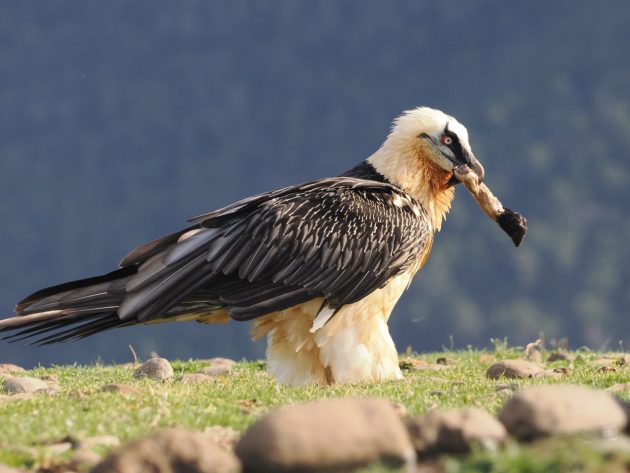
It only stayed for a few minutes, but remained around long enough for my companion David and I to take numerous photographs, and for it to swallow a few bones. It totally ignored the assorted company of Griffons and Ravens, while they took no notice of it. Lammergeiers often feed in pairs: the fact that we only saw one bird suggested that its mate was incubating. Incubation is a lengthy business, taking from 55-60 days. However, the sexes are identical, so visually sexing them is almost impossible. Thus it’s quite likely that my photographs are of the female, as she incubates exclusively at night, but the male shares incubation duties with her during the day. I’ve looked at my pictures carefully to see whether we might have been seeing two different birds, but haven’t managed to notice any plumage differences that suggest this could be the case.
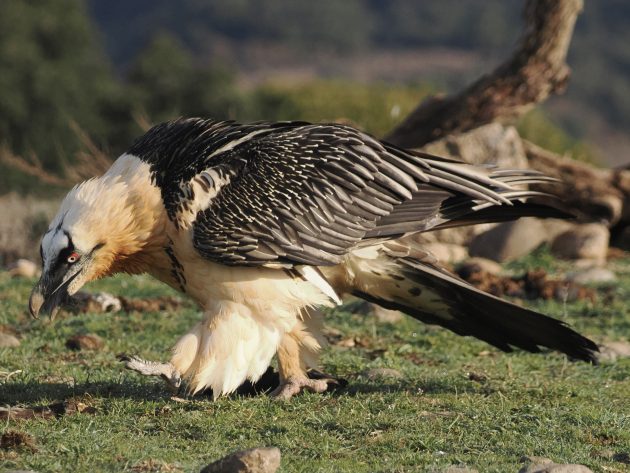
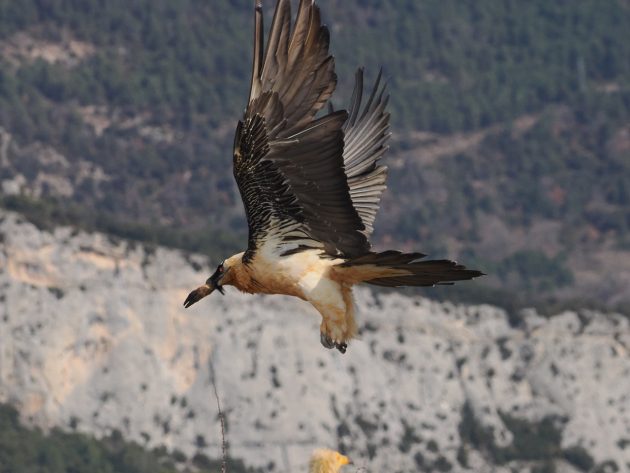
What we assumed was the same bird made two more visits, each one relatively brief. On one occasion it flew off with a bone grasped firmly in its foot. This is un-vulture like behaviour, for Griffons never carry food in their feet, but is commonly recorded with Lammergeiers. My companion in the hide, David Tipling, remarked that my photograph of the bird with the bone “looks like someone holding a baton in a relay race”, which I reckon is an apt description.
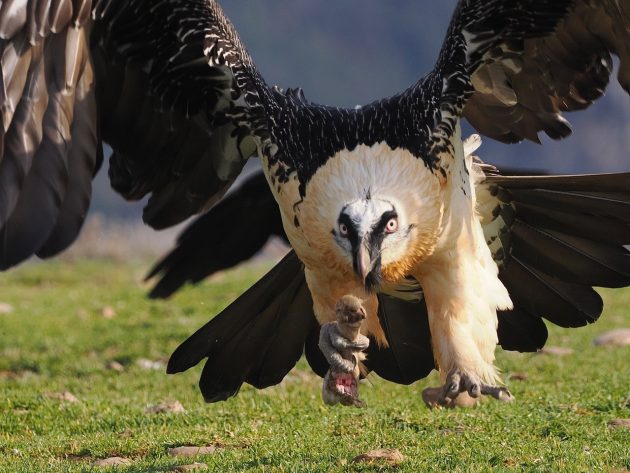
After the morning show it didn’t come back in the afternoon, though on a couple of occasions it soared low overhead, the giant shadow passing the ground in front of us revealing its presence. On our second day in the hide its appearances were much the same, though it was a duller morning and it didn’t arrive for breakfast until 9.17, so notably later than the day before.
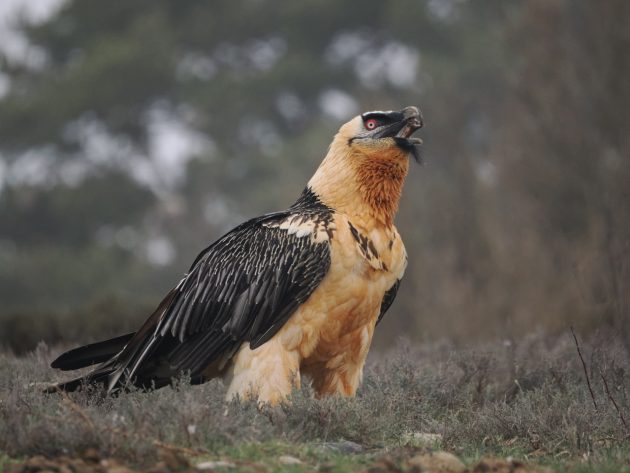
Lammergeiers are well adapted to their diet of bones, with an enormous gape that is 70m wide. This allows them to swallow large bones of up to 250mm long and 35mm wide; our bird didn’t attempt to swallow any bones of this size while we were watching, but it had no problem swallowing smaller bones, throwing its head up to help the bones down. Incidentally, these birds have very acid digestive juices to enable them to dissolve large bones. They also prefer older, drier bones to fresh ones.
Lammergeiers are well know for their habit of picking up and dropping large bones in order to crack them. Some years ago I watched one doing this repeatedly with the same bone, which it clearly was having problems with breaking. According to legend, the Greek playwright Aeschylus met a tragic death when “an eagle” (quite possibly a Lammergeier) dropped a tortoise on his bald head, and accidentally killed him. I have seen Golden Eagles dropping tortoises in Greece, so this might be a crime that was committed by an eagle rather than a Lammergeier.
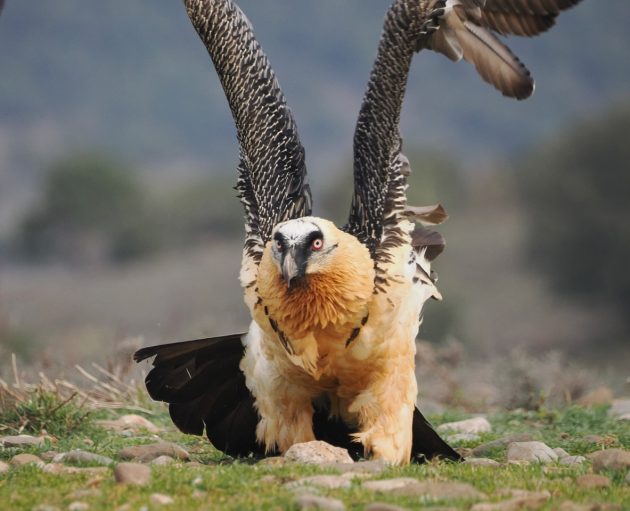
One interesting fact about these birds is that the orangey colouring of the birds’ underparts is due to the accumulation of iron oxide onto the feather barbs. If it wasn’t for this staining they would be white underneath. According to the authoritative work The Vultures of Africa (Academic Press, 1992), “the vultures acquire the colouring during their normal routine of bathing, loafing on leges, and investigating caves; the deposits are spread around the plumage by preening”.
Lastly, perhaps I should apologise for using the name Lammergeier rather than Bearded Vulture. The name Lammergeier comes from German (Lamb Vulture), and refers to the fact that these birds were once thought to be predators of lambs, snatching them from the flocks grazed on the alpine meadows. Such behaviour has never been recorded, so it’s widely thought that the name Lammergeier is both misleading and inappropriate. However, this name (at least to an English speaker like me) has a more romantic ring to it than Bearded Vulture, which suggests a bird in need of a shave. I do like the Spanish name, Quebrantahuesos, which means bone-breaker, but it’s harder for an Englishman to pronounce.
My photographs were taken from a hide situated near Salsona in Catalonia, Spain. For more information, contact info@photo-logistics.com, or look at www.photo-logistics.com.





Wow! What magnificent birds you captured in your photographs. I happen to find vultures fascinating. I enjoyed your piece very much.
Excellent account, David – it’s a bird I have long dreamt of seeing. While I appreciate both German and Spanish names, I don’t seem to have a problem with Bearded Vulture…
Thanks for the photos and story. Top rate!
Thanks for such good photos and very interesting facts of Quebrantahuesos, an apt name that is fun to say (Spanish is my 2nd language).
I gather it is birds from the reintroduction programmes that are most likely to disperse far afield. I did not see the one that showed up in England a few years ago and hung around for many weeks, but I am very envious of those who did. Also, what an incredible shock it must have been to see one suddenly appear in what passes for mourntains in England!