

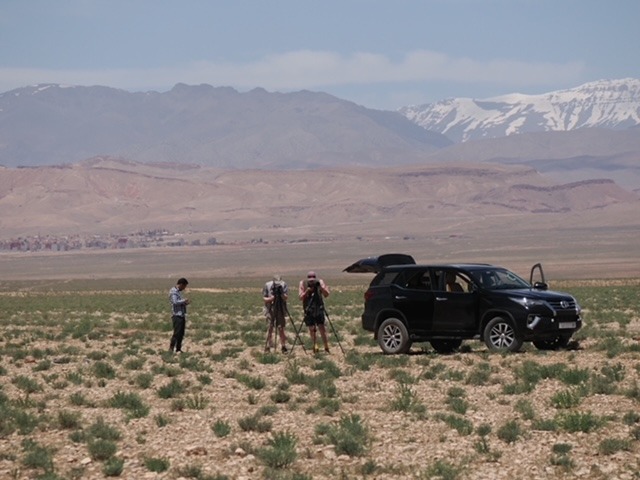
Waking up on the first day of a trip is always exciting, and it certainly was on my first morning in Morocco. It was 5.15, and still completely dark, but through my open window I could hear a distant nightingale. Minutes later came the first call for prayer, a reminder that I was in a Muslim country. I enjoyed a pleasing tingle of anticipation at the thought of the week ahead.
I met my companions soon after dawn, and we enjoyed finding a few birds before breakfast: African Blue Tit, a White Wagtail of the distinctive race subpersonata, a Grey Wagtail, a small flock of Crossblls and our first Common Bulbuls, the latter really confirming that we were in Africa, not Europe. Later, while loading the car, a trio of Red-Rumped Swallows flew over, and a single White-rumped Swift dashed down the valley. It was the only one of the trip.
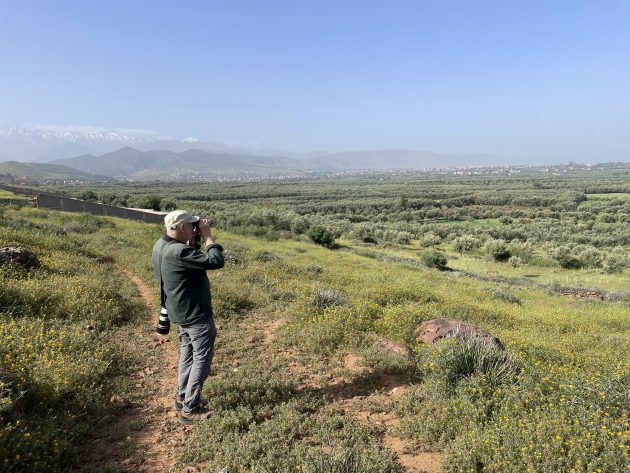
We were off at 8.30 sharp, but had one last stop before heading into the desert. It was at a place called Ghmat: by Moroccan standards the farmland was lush with wheat and orchards. It was a pretty spot, with a distant background of snow-capped mountains (above), while the sun shone and the temperature was a very pleasant 24 or 25degC. Here from our hillside viewpoint we heard our first Turtle Doves, glimpsed Barbary Partridges, watched Corn Buntings and Maghreb Magpies and enjoyed our first Woodchat Shrike, a smart male. We also saw a pair of Black-eared Wheatears.
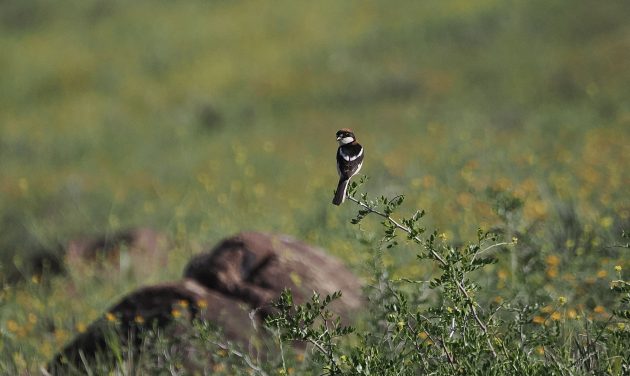
Migrant Woodchat Shrike
Maghreb Magpies are interesting. They have recently been awarded full specific status, so are no longer regarded as just a race of the widespread European Magpie, to which they are clearly very closely related. However, they sport a dashing patch of blue skin behind the eye, white they are shorter-winged and their plumage lacks the green gloss of Pica pica.
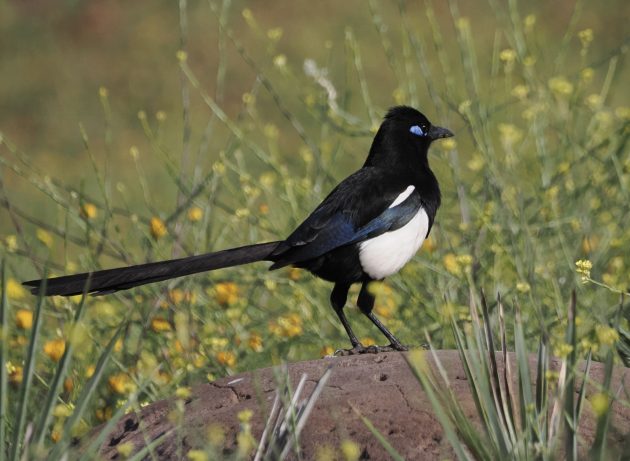
The Maghreb Magpie now has full specific status. Note the bare blue skin behind the eye
After this brief but enjoyable interlude we set off for the desert, our route taking us over more mountains before we started to descend into the desert. But though the countryside became increasingly arid, there were still a remarkable number of villages, invariably in shallow river valleys where there was enough underground water to let the date-palms grow.
Our destination was the oasis town of Souk Lakhmis Dades, and here we could walk from our guesthouse through narrow shaded passageways, past houses made of mud and straw, down to the gardens – in reality a myriad of tiny, irrigated fields, each edged with small trees and shrubs. It was a site that was at its very best at dawn, when the air was filled with bird song: the purring of Turtle Doves, the outpouring of Nightingales and the bubble of Bulbuls. Laughing Doves joined in the chorus, their laughing calls (they are well named) adding a little touch of Africa.
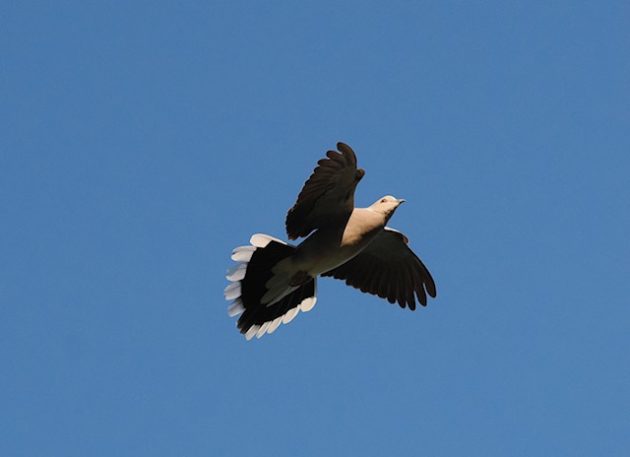
Displaying Turtle Dove
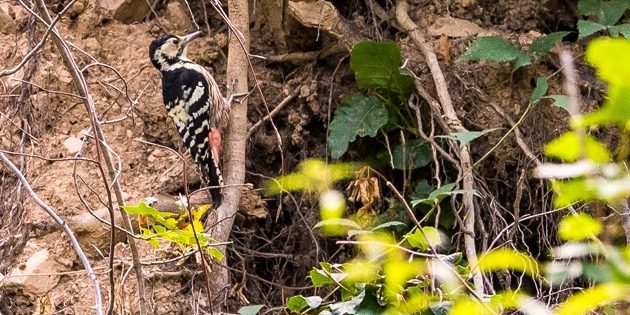
Our target bird here was another North African endemic, Levaillant’s Green Woodpecker. At first it played hard to get, and we became briefly excited by an unseen, drumming Great Spotted Woodpecker, a bird that is increasing its range in Morocco. Eventually, though, the Levaillant’s showed well – completing my set of all 11 species of Western Palearctic woodpeckers.
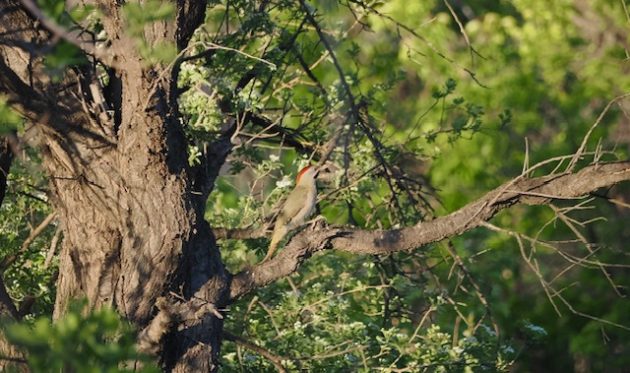
Levaillant’s Woodpecker, a North African endemic
We stayed at Dades because it was close to the legendary Tagdilt Track – an expansive, open desert landscape dominated by wormwood scrub and gravel plains. Despite its seemingly harsh conditions, it is an area that supports an impressive diversity of highly specialised desert species. These were the birds we had come to see.
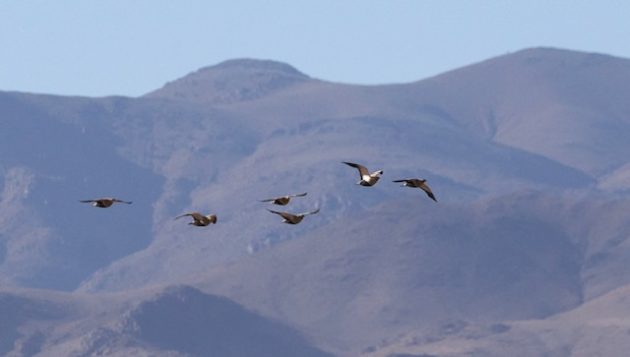
Black-bellied Sandgrouse flighting to water (above and below)
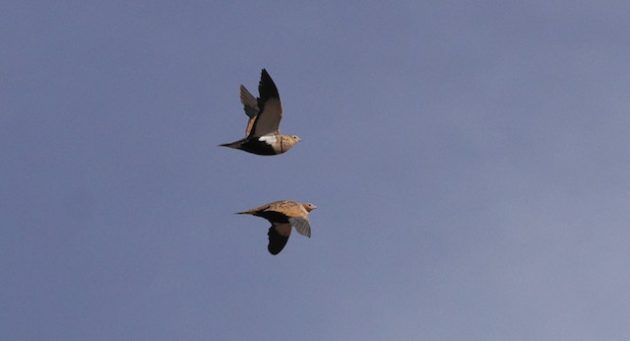
We had to be out on the Track early, in order to see the sandgrouse flighting to water, something they do first thing every morning. There are few more delightful experiences in the desert than watching these extraordinary birds travelling in from distant parts of the compass. Some will fly as far as 50 miles every day just to find water. Most of the birds we watched were Black-bellied, but they were joined by a few Crowned, a new bird for me, and one that I’d long wanted to see. I wasn’t disappointed, for they are exquisite birds.
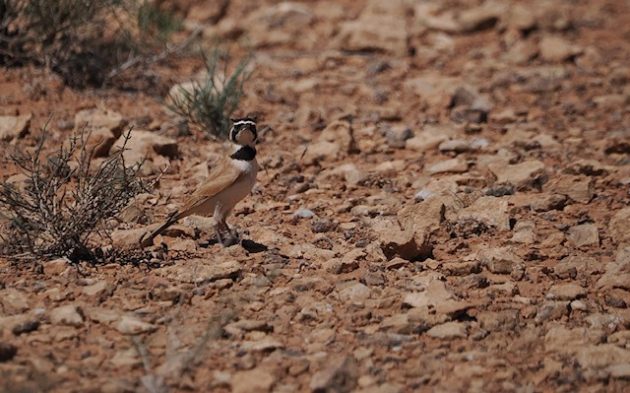
Temminck’s Horned Lark. The harsh light of the desert makes photography difficult, even if the birds are co-operative
In the next few hours the birds kept coming: pink Trumpeter Finches were great to see, while we soon started to tick off the other desert specials: Red-rumped and Desert Wheatears; Desert, Short-toed, Hoopoe, Thick-billed and Temminck’s Larks and our first Cream-coloured Courser, the latter an immaculately plumaged desert wader I’d only seen a few times before.
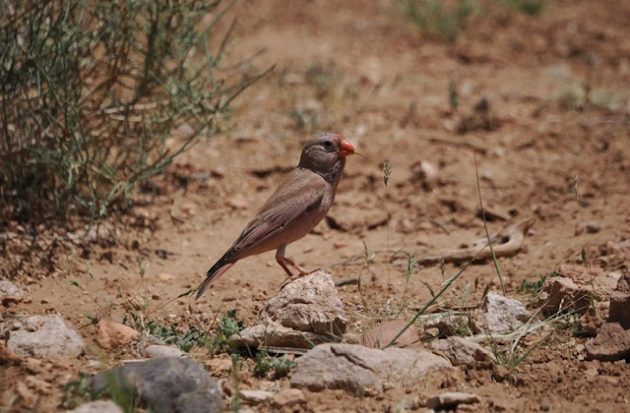
Trumpeter Finch – a big-beaked, pink finch of the desert
At a location like this you become reliant on your guide’s knowledge of where to find your quarry: locating birds here without a guide would be akin to looking for a needle in a hay stack. Fortunately Omar knew exactly where to look, and his success rate was 100%. I was impressed.
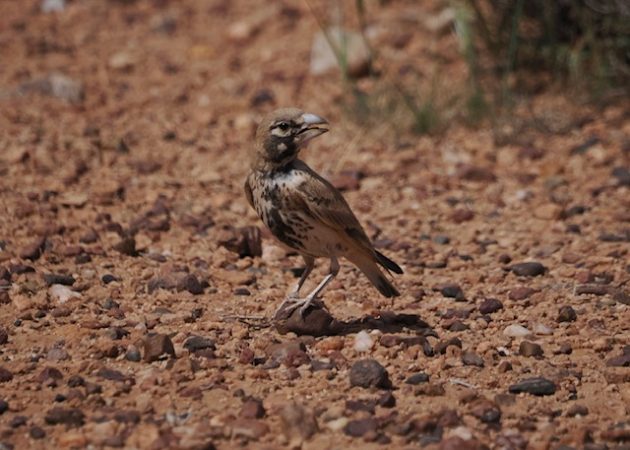
Thick-billed Lark
Having enjoyed our feast of desert birds, Omar had two more specials to show us: Pharaoh Eagle Owl and Lanner Falcon. To find these we left the flat desert and drove to a remote rocky canyon where we abandoned our 4×4 and set off on foot. Our first bird was an Atlas Buzzard. This is a curious creature, as it looks like a Long-Legged Buzzard, an eastern species, but is much more closely related to the Common Buzzard. I think that it’s best ticked as an Atlas Buzzard, which is what we did.
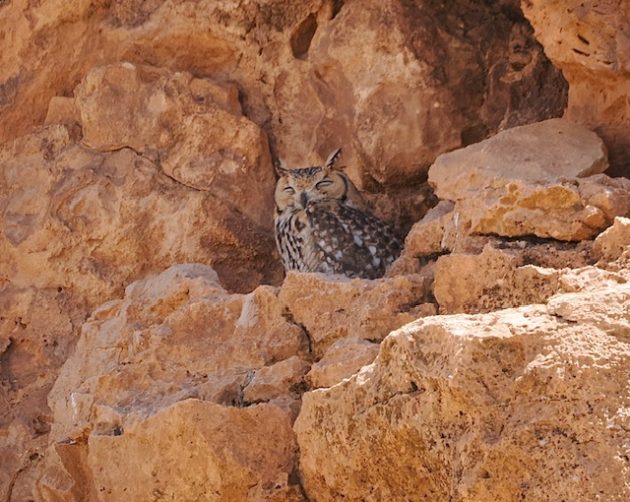
Pharaoh Eagle Owl, a speciality of the desert
I’d only seen a Pharaoh Eagle Owl once before (roosting on a pyramid in Egypt) so this was a bird I was keen to see again. Finding one seemed a major challenge, but Omar knew where to locate them. We started with an almost-fledged youngster, glowering at us with orange eyes from deep with a cave, but we went on to find a dozing adult, looking like a small, sandy Eagle Owl, on the cliff behind us. Brilliant. As we left, a Maghreb Wheatear appeared, another lifer.
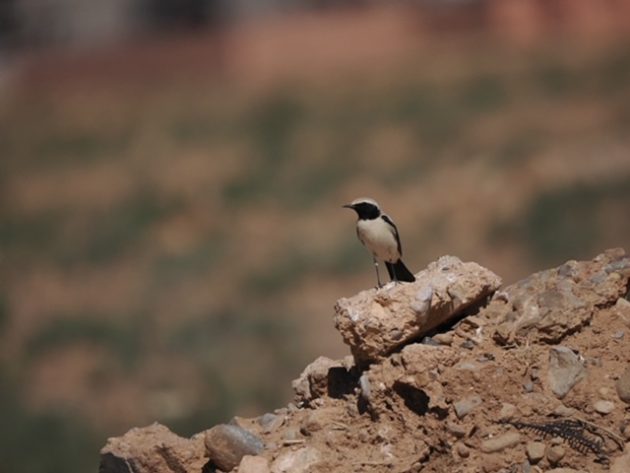
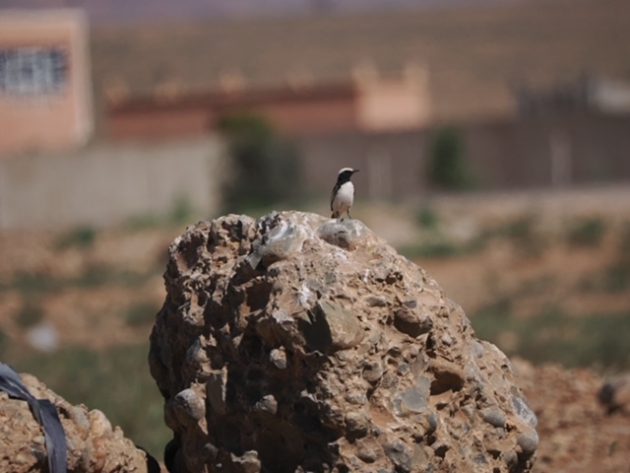
Desert Wheatear (above) and Red-rumped Wheatear below. Identifying wheatears can be tricky
And the Lanner? Sad to say, it was our only failure of the day, as it failed to keep its appointment with us. Omar thought the chicks had fledged, and the birds were away hunting. One miss is nothing when you have had more than a dozen great hits, as we had done. We slept well that night after a remarkably successful day in the desert.
To be concluded.







I am not sure, David, that you should have tried to see the owl again. The sheer poetry of an pharaoh eagle owl on a pyramid… Morocco is an amazing country for birding and your stories brought back a lot of very happy memories. What a way to start my Saturday.