

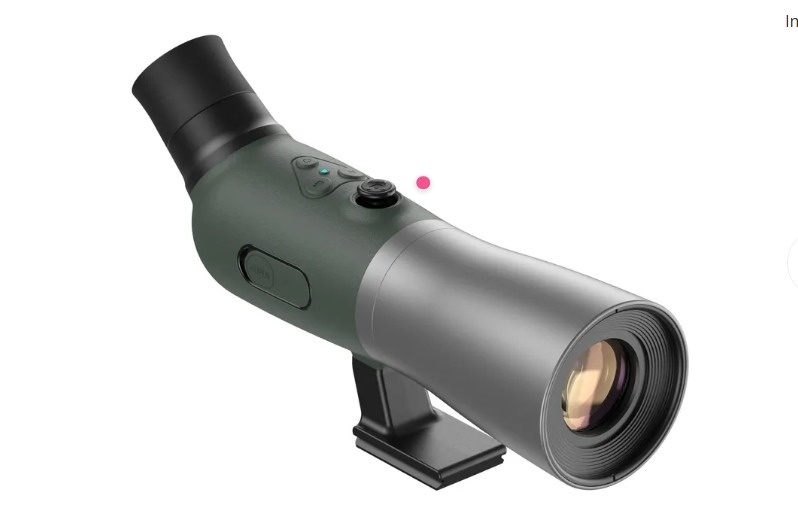
As mentioned in another recent review, several Chinese companies are currently introducing consumer-level electronic birding devices – binoculars and spotting scopes – with or without an AI component, but all with incredibly long names. The GoBirding Vision Master Smart AI Spotting Scope reviewed in this post is one of them.
The device claims to combine long-range observation, 4K imaging, optical image stabilization, autofocus, and AI-powered bird identification in a lightweight handheld design. Does it?

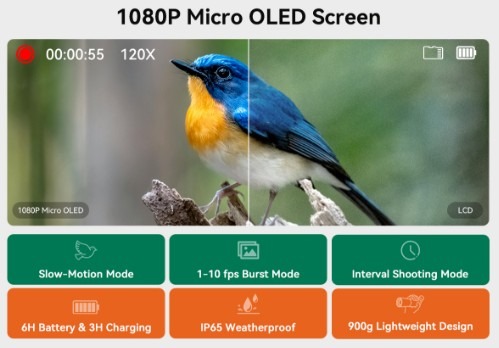
The manual states an optical zoom range of 1×–30× and a digital zoom range of 31×–120×. While the Vision Master is lightweight enough for handheld use, the manufacturer recommends pairing it with a professional tripod at higher magnifications to achieve greater image stability and a more comfortable birdwatching experience.
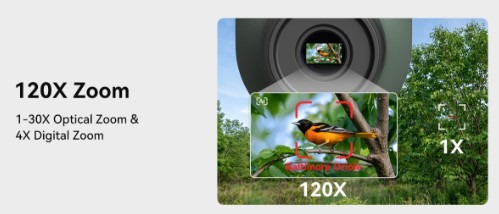
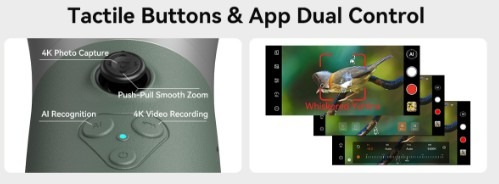
So, what does the device add to a traditional scope? Mainly, two functions. First, it allows taking photos and videos directly while using the device rather than using more complicated techniques such as digiscoping (which, admittedly, I never got the hang of). The image quality naturally does not match that of a dedicated camera, but it is more than adequate for documentation..
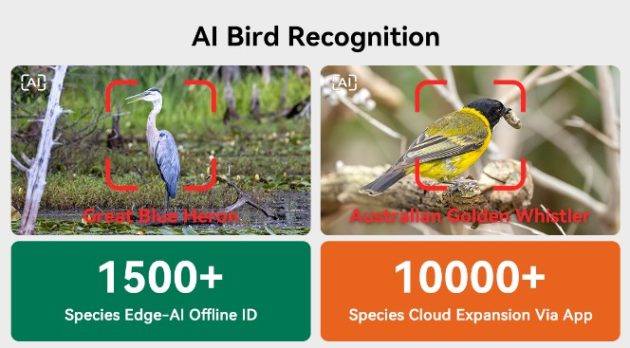
Second – though in my opinion maybe somewhat less important – is the AI function. When a button is pressed on the device, it aims to identify the bird in the center of the frame. A Pied Kingfisher taken in my initial indoor tests was easily recognized, so was a Light-vented Bulbul in the field (at a magnification of about 35x), while a Fairy Pitta (photo, indoors) remained unrecognized. According to the company, the on-device offline recognition can identify about 1,500 species without internet access. The companion app, accessed via a mobile phone, covers more than 10,000 species—and it identified my beloved pitta.
The build quality of the device looks good, though admittedly, I failed to do any serious testing. I certainly wouldn’t be embarrassed to be seen using the Vision Master in the field.
Setup and handling of the device are fairly straightforward. I occasionally struggled to locate birds with the device, though I suspect this says more about my long-standing difficulties with spotting scopes than about the Vision Master itself. So, as long as the limitations of scopes over binoculars – e.g., for small, fast-moving birds nearby – are acknowledged, the (deep breath) GoBirding Vision Master Smart AI Spotting Scope offers a promising combination of scope capabilities and added photo and ID functions.
Ultimately, much will depend on pricing. The Vision Master offers capabilities that conventional spotting scopes do not, but it will also need to be affordable enough to appeal beyond the relatively small market of highly dedicated, wealthy birders. Presumably, the website of the device will provide more information on this in the future.













Very curious to see what the price tag will be. For the benefit of this website I have started carrying around a Nikon P900 which will allow me to take pictures of dubious quality (you wouldn’t want it any other way) but this eliminates the possibility to bring the scope. If the GoBiViMaSmAI Spotting Scope could help with that conundrum, great!
Interesting and timely concept. How much does it weigh?
According to their website, it weighs about 900 grams, or slightly below 2 US pounds. Not heavy, but at least at larger magnifications it will be hard to use without a tripod, which will add some weight.
I went looking for field of view and found this interesting tidbit: “In place of a traditional optical eyepiece, the M One uses a 0.49-inch OLED display at 1080p resolution. That’s a fundamental difference from conventional scopes, and for birders accustomed to a direct optical view, it could be a sticking point.”
AI tells me: The GoBirding Vision Master Smart AI Spotting Scope (model APL-ETF-M1) is a handheld, AI-powered optic for birders. Retailing between $699 and $999, it merges 30x optical (120x hybrid) zoom, 4K/30fps video, Optical Image Stabilization, and real-time subject tracking into one device.