

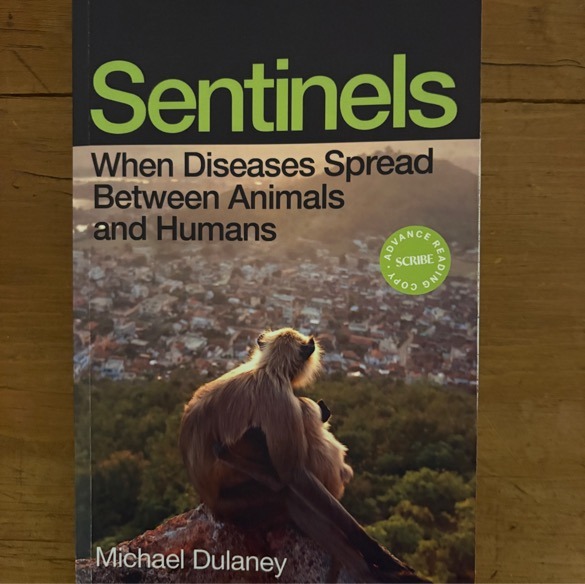
I recently had the opportunity to read an advanced copy of Sentinels, by Michael Dulaney. The title is an epidemiological term referring to animals that provide an early warning of disease before humans are affected. The subtitle, When Diseases Spread Between Animals and Humans, hints that the early warning system may have failed.
I should say from the outset that this book is not about birds, although it does discuss Avian influenza in great detail (spoiler alert, this pathogen can also cause disease in other wildlife). However, most bird lovers, myself included, share an interest in the intersection between humans and the rest of the natural world and for that reason Sentinels is well worth the read.
Many of the chapters are fascinating and well written case studies of medical detective work. For example, Dulaney describes a Hendra virus outbreak in the horse breeding community of Australia. He discusses Valley Fever, a fungal disease on the rise in the Southwest United States and devotes a chapter to Avian influenza, its rise in the poultry industry and the role of wild aquatic birds as a natural reservoir. For each zoonotic disease he links the human activity that has lead to its spread, i.e. massive real estate development, industrial agriculture, factory farming, etc. Dulaney draws a link between these diseases and the ills of capitalism which he describes as “a system that takes the whole of biological life and turns it into a machine for extracting maximum value”.
Sentinels is also an example of great story telling. We learn how and why Trench Fever from WWI is on the rise in Edmonton, Canada. We learn about Goldie, a pig genetically engineered to resist disease. And we learn how feral hogs in East Germany might have brought about the fall of communism. This makes for fascinating reading. But reading about multiple facets of this existential crisis can be challenging. Indeed, writing Sentinels was probably no walk in the park. Dulaney is at times open about his own ecological fears and grief in a way that is quite touching. In the end, he admits, “we know the problems but we can’t get anyone to act on them”. Is he saying that writing Sentinels was an exercise in futility? Would I argue with him? I’m not sure. At the end of the day, Dulaney’s hope is to inspire the reader to ask, “what could or should we be doing differently”. I suspect most anyone who is inclined to read Sentinels is already asking that question.
Planned Publication: Oct. 6, 2026






Leave a Comment