

By MD Imdadul Haque
MD Imdadul Haque (Bangladesh) is the founder of BirdzFly.com. The site aims to provide insights into birds, their behavior, and their conservation.
Every August, the same thing happens across backyards in the eastern United States. A feeder that was busy all summer goes quiet. The hummingbirds seem to have vanished overnight. People assume migration happened while they weren’t paying attention.
What actually happened is more interesting — and the timing is almost never what people think.
Fall hummingbird migration doesn’t happen all at once. It happens in three distinct waves spread across three months, and most people only notice the last one.
**Wave 1: The Males Leave in July**
Adult male Ruby-throated Hummingbirds start leaving their breeding territories in late June and July. In Canada and the northern US, this departure begins in mid-July. By early August, most adult males have already gone.
This surprises people. July feels like the height of summer. Flowers are blooming. The garden looks exactly like it did in June. But the adult males are already responding to shortening days — the same photoperiod signal that triggers spring arrival in reverse — and they have no biological reason to stay. Their role ends when breeding is complete. They don’t incubate eggs, they don’t raise young, and there’s nothing tethering them to a territory once the season is over.
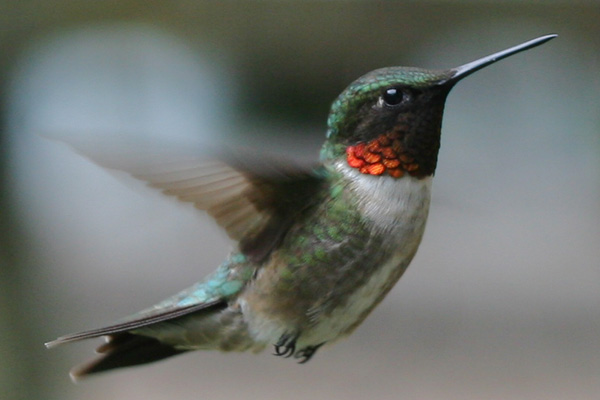
The result is that birders lose the most visible birds first. The adult male with his iridescent ruby throat, the one most people picture when they think “hummingbird,” is the first to go. What remains at feeders through July and into August are females and juveniles — and since females and young birds lack the dramatic throat patch, they are easier to miss.
**Wave 2: Adult Females Depart in August**
Females finish raising the final brood of the season and begin moving south in August. Timing varies by latitude: females in New England may start leaving in late July, while those in Tennessee or the Carolinas might not begin until mid-August.
The window between male departure and female departure is usually three to four weeks. During this overlap, feeder activity can seem stable — roughly normal numbers of birds, just different individuals — which masks the fact that the entire adult population has turned over.
By late August, most adult females from northern breeding populations are underway.
**Wave 3: Juvenile Birds in Late August and September**
This is the wave most people notice. First-year birds — hatched that summer, making their first migration south — move through in late August and September. They are the last to leave because they were the last to be born.
These juveniles are navigating entirely on innate programming. No learned route, no experienced adult to follow. They inherit a directional sense that pulls them south and southwest, toward the wintering grounds in Mexico and Central America, and they follow it without any prior knowledge of what lies ahead.
Feeder activity often peaks during this third wave. The birds are inexperienced at finding food on a migration route they’ve never traveled, and a well-stocked feeder represents a reliable energy source they will use heavily. At the same time, many of these birds are in hyperphagia — the pre-migration state of intensive feeding where they eat almost continuously, building the fat reserves that will fuel the Gulf crossing. A hummingbird in hyperphagia can gain 25 to 40 percent of its body weight in a week or two.
This is the week most people associate with “the hummingbirds are leaving.” In reality, the adults left weeks ago. What they’re watching is the juvenile population fueling its first nonstop transoceanic crossing.
**What Triggers Migration: It Is Not the Feeder**
One of the most persistent myths in backyard birding is that keeping feeders up in fall prevents hummingbirds from migrating. It doesn’t.
Migration is triggered by photoperiod — the changing ratio of daylight to darkness as days shorten after the summer solstice. This signal operates regardless of food availability. A hummingbird that is physiologically ready to migrate will leave whether the feeder is full or empty. The feeder does not cause migration and cannot prevent it.
What the feeder can do is provide fuel for birds that are actively migrating. Keeping feeders up through late September in the Northeast — and into October along the Gulf Coast — ensures that late migrants and first-year birds have access to energy when they need it most. Taking feeders down in early September, when the juvenile wave is at its peak, removes a resource precisely when it’s most useful.
**Why This Matters for Backyard Birders**
Understanding the three-wave structure changes how people read their feeders in late summer.
The quiet period in late July isn’t the end of hummingbird season — it’s the gap between the adult male departure and the beginning of the main fall movement. The spike in activity in late August isn’t the start of something; it’s the tail end of a months-long process. And the feeder that seems pointless in mid-September — when days go by with nothing visiting — may still be serving occasional stragglers and western strays that have wandered off their normal routes.
The Ruby-throated Hummingbirds most backyard birders watch are making a round trip of roughly 3,000 to 5,000 miles, including a nonstop overwater crossing of the Gulf of Mexico. The fall half of that journey is quieter and less dramatic than spring — no males singing from prominent perches, no territorial chases, no courtship displays. It’s a dispersed, individual movement that doesn’t announce itself.
But it’s happening, in three waves, from July through September, in backyards all over eastern North America.
Photo by Corey













Leave a Comment