

By Itamar Procaccia, The Weizmann Institute of Science, Rehovot 7610001, Israel
Itamar Procaccia is a professor at the Weizmann Institute in Rehovot, Israel, specialising in the Physics of Complex Systems. During his career, he worked on and contributed to the study of chaos in physical systems, the turbulence of fluids, the physics of disorder, and the creation of fractal geometries in nature. Besides physics, he is an avid art collector and enjoys bird photography as a serious hobby.
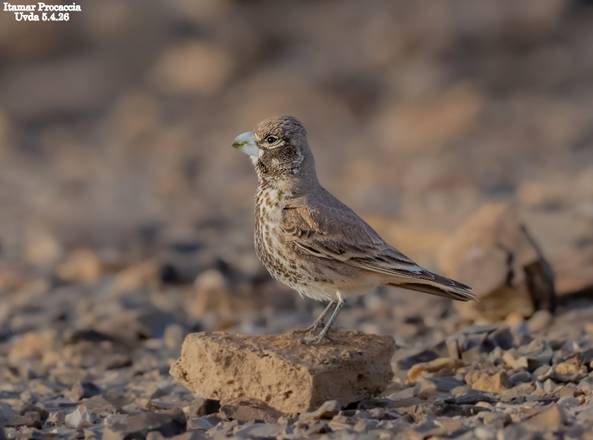
The Negev Desert in Israel, a region that spans the area between Beersheba in the North to Eilat on the coast of the Red Sea, is a very arid area indeed. In its southern part, the average yearly rainfall is about 30-50 mm. There are, however, extreme events in which heavy rains fall in sudden downpours, and the desert changes its appearance. In a short time, it gets covered with green vegetation and many flowers, suddenly able to sustain ample food for desert birds, both as seeds and as arthropods. The last such event was recorded in the winter of 2009-2010, and another one has occurred just recently in 2026. In both cases, a fantastic number of specimens of Thick-billed Larks, birds that are usually extremely rare in Israel, appeared from nowhere, and pursued mating and nesting on a scale that is unimaginable in regular years.
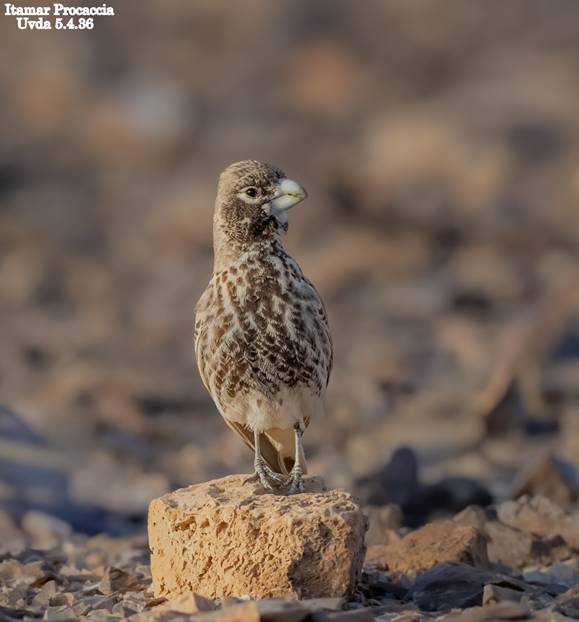
Regularly, Thick-billed Larks (Ramphocoris clotbey) are found in northern Africa from Mauritania and Morocco to Libya, also in the central regions of the Arabian Peninsula. Its natural habitats are dry shrubland and hot deserts. In normal years, it remains extremely rare in the Negev desert, and observing it, not to say photographing it, is very hard indeed. The desert camouflage does not help to find them when their number is extremely small.
This year offers a rare opportunity to photograph Thick-billed Larks in Israel. You see them in numbers, and catching them standing on stones is relatively easy, as if they like to be photographed. Their huge bill is advantageous in cracking hard seeds, but also in digging the hard soil for bulbs.
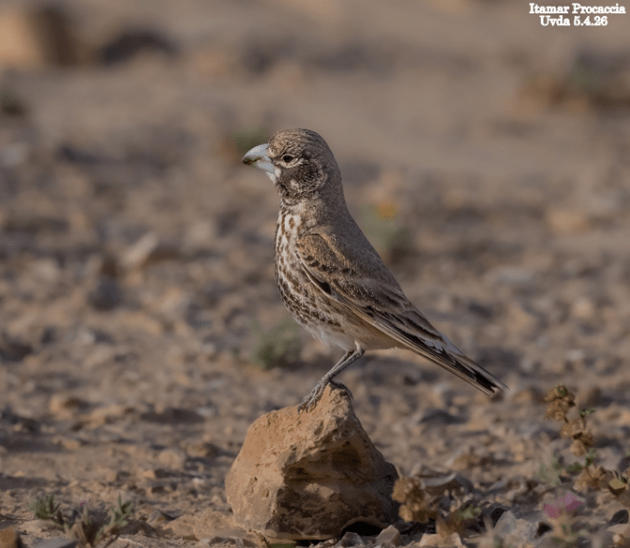
A very interesting question is how these Larks know that the conditions in the Negev desert are favourable? Researchers claim that the sound of distant thunder or the smell of rain are the clues, but to me, there is no convincing answer to this question; it is still unclear how significant numbers of Thick-billed Larks appear from nowhere and inhabit the Negev with active nesting. The duration of the nesting activity is short, and they can complete two, and sometimes three nesting cycles in one season, as long as food is available.
At any rate, for bird watchers and bird photographers, this is a rare opportunity to enjoy this natural phenomenon; the Thick-billed Larks are easy to find and to photograph. Possibly the next time for such an opportunity will be many years in the future.






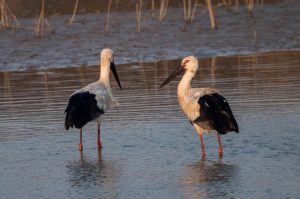




These (and other) desert larks of the Palaearctic region are probably easier to find in Morocco (not only due to the concerns Itamar already raised but also the present security situation). Wherever you want to go these little birds are quite amazing.
We were in Israel in October 2013. Itai Shanni guided us. He played a call and a Thick-billed Lark landed at our feet. What an amazing little bird.