

By Nate Cook
Nate Cook has been fascinated by birds for as long as he can remember. He works in data analysis, which turns out to be a good way of paying closer attention to what happens at the feeder. He runs Feederbarn, a website providing information on bird feed and feeding preferences.
In 2014, Horn, Johansen, and Wilcoxen published a study of seed and feeder use across the United States and Canada. Its abstract contains a sentence that belongs above every seed aisle: bird-feeding traditions “are often conflicting and have not been verified empirically.” Their study measured preference. I looked at something duller, and it still settled a few of those traditions.
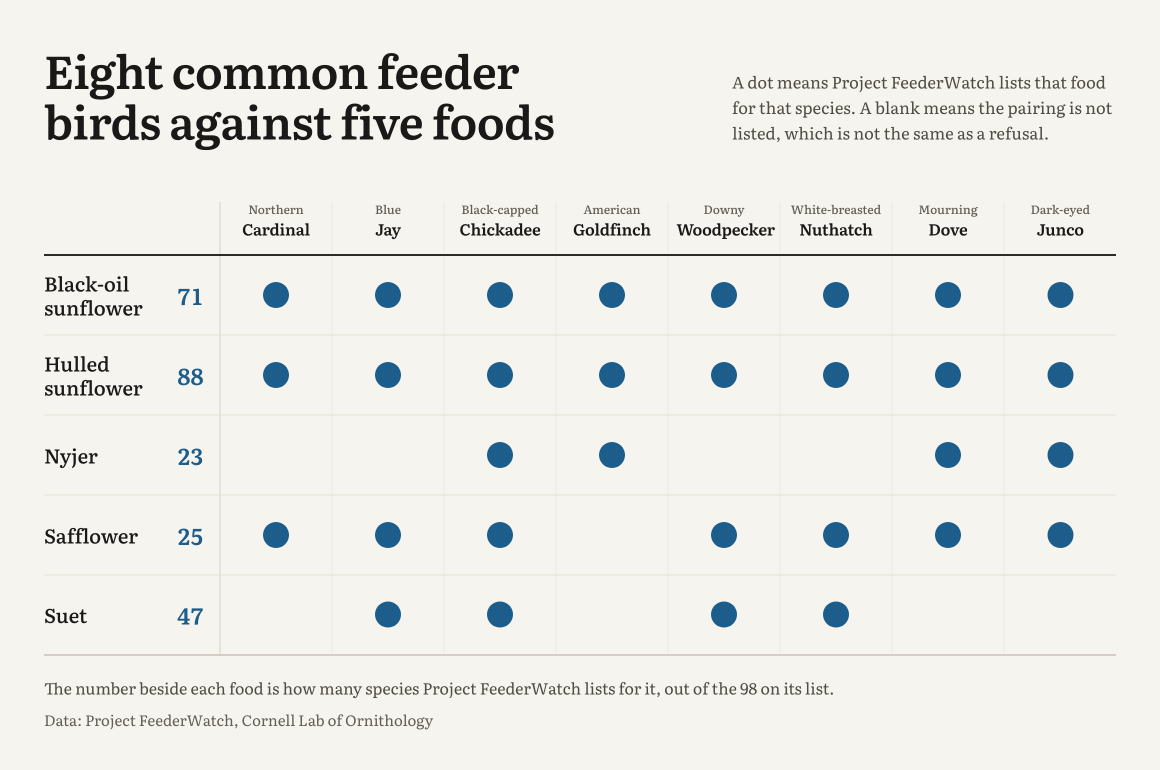
The Cornell Lab of Ornithology’s Project FeederWatch publishes a page called Common Feeder Birds, which tags each species with the foods and feeder types Cornell lists for it. In August 2026, it held 98 species and 14 foods.
(Two warnings before the numbers. These are not bird counts, and they are not preference trials. When I say a bird “takes” a food, I mean Cornell lists that pairing. A food missing from a bird’s row means Cornell doesn’t list it, which is not the same as the bird turning it down.)
Sunflower swallows the seed mix
Hulled sunflower is listed for 88 of the 98 species, which is not news. What surprised me is how thoroughly it covers the seeds people argue about. Every bird that takes milo (32 species), millet (41), cracked corn (48), oats (12), safflower (25), or nyjer (23) also takes hulled sunflower. Not most of them: all of them.
Black oil sunflower, listed for 71, misses seven of those birds. Chipping Sparrow and both meadowlarks, for example, appear under cracked corn and hulled sunflower but not under black oil, so the choice between the two sunflowers matters. With hulled sunflower already on offer, adding milo or millet buys no new species.
To be fair to milo, breadth is not the only measure. In Cornell’s own seed preference tests, Steller’s Jays, Curve-billed Thrashers and Gambel’s Quail preferred milo to sunflower. These tables can’t see that; they measure breadth, which is a different question from preference.
The ten birds sunflower misses
Ten species in the tables are not listed for hulled sunflower. The four hummingbirds (Anna’s, Black-chinned, Ruby-throated and Rufous) take sugar water and nothing else. Cedar and Bohemian Waxwing take fruit and nothing else. The remaining four are Baltimore Oriole, Eastern Bluebird, Hermit Thrush and Yellow-bellied Sapsucker, and each takes some combination of fruit, suet, mealworms and sugar water.
Peanut hearts also reach two of the ten, the bluebird and the thrush, but both already take fruit and mealworms. Put hulled sunflower, fruit, and sugar water together, and you cover 97 of the 98. The holdout is the sapsucker, listed only for suet and mealworms.
Audubon makes a similar point: “Fruit specialists such as robins, waxwings, bluebirds, and mockingbirds rarely eat birdseed.” Cornell’s tables are a little more generous. The waxwings and the bluebird take no sunflower, but American Robin and Northern Mockingbird are both listed for hulled sunflower.
It seems that most arguments over which seed is best are really arguments over which birds you would rather not feed. If you want a longer list than sunflower gives, the answer is suet, fruit, mealworms or sugar water rather than another seed.
Safflower and the grackles
Safflower’s reputation is that it keeps grackles away. Cornell lists both Common Grackle and Great-tailed Grackle for it, along with Rock Pigeon and Mourning Dove. So much for that.
It is selective, only about different birds. Take a list of ten species that tend to get called feeder problems. Seven are missing from safflower’s 25: House Sparrow, European Starling, Brown-headed Cowbird, Red-winged Blackbird, Brewer’s Blackbird, American Crow, and Eurasian Collared-Dove. The three that remain are the two grackles and the pigeon.
(“Problem” is not a biological verdict. Starlings and House Sparrows are non-native; the grackles, the cowbird, and the Red-winged Blackbird are native birds that simply turn up in numbers.)
Nor does safflower bring anyone new: all 25 of its species also take black oil sunflower, and American Goldfinch, listed for both sunflowers and nyjer, is missing from it. FeederWatch says as much: “In our experience, most birds prefer sunflower seeds over safflower” (source). So, safflower is a sensible choice if starlings and House Sparrows are the trouble, and a poor bet if grackles are the reason you bought it.
What the usual (unliked) suspects eat
Run the same ten down the rest of the chart, and some results are blunt. Millet and cracked corn are each listed for all ten. Nyjer is listed for none. Project FeederWatch publishes one reader’s remedy for a House Sparrow invasion: “avoid millet, cracked corn, and all ground feeding”.
I don’t think any of this makes a cheap mix a scandal. But a bag built on millet and cracked corn reaches fewer species than sunflower alone and not one fewer of those ten birds, which seems an odd thing to pay for on purpose.
Additional sources used:
- Horn, Johansen and Wilcoxen 2014: https://wildlife.onlinelibrary.wiley.com/doi/10.1002/wsb.365
- Cornell’s Common Feeder Birds tables, the data behind every count here: https://feederwatch.org/common-feeder-birds/
- Safflower and sunflower preference: https://feederwatch.org/learn/feeding-birds/food-types/
- Milo preference tests: https://www.allaboutbirds.org/news/types-of-bird-seed-a-quick-guide/
- Audubon on fruit specialists: https://www.audubon.org/magazine/11-tips-feeding-backyard-birds






Leave a Comment