

Over the past year, we’ve profiled about 60 bird guides from 35+ countries. Each of them brings unique knowledge of their own local conditions.
Now, while continuing the series as before, we add another format. In this one, instead of one guide answering many questions, many guides answer just one. Hopefully, by putting the same question to many professional birders from around the world, we will see patterns emerge. For our second post in this series, we asked
What skill or habit do you wish more visiting birders developed?
Group birders sometimes socialize and chat too much instead of listening and looking for species. Gabor Orban, Hungary/Costa Rica
Patience — it’s not a zoo. Mohamed Bargache, Morocco
Patience, field discipline, confidence, and quiet observation. Magada Haily Miriam, Uganda
Doing research before visiting, choosing community-based tourism, and thinking about conservation and reciprocity. Asherita Viajera, Colombia
List building and continuous documentation of birding locations and habitats. Dibyendu Ash, Sikkim, India
I wish more birders would practice patience. In a dense forest like Nyungwe, birds are not always easy to spot quickly. Those who take time to listen, observe quietly, and enjoy the forest’s atmosphere often end up seeing more species and having a richer experience. Jacques Habimana, Rwanda
Practicing quiet observation — slowing down instead of just ticking birds off a list. Steven An, China
Being quiet and patient when waiting for a bird. Ernesto Reyes Mouriño and Tania Piñeiro, Cuba
Using their ears more often. Tom Tarrant, Australia
I wish more people appreciated the birds’ viewing than just checking it off their checklist without appreciation of the bird’s beauty. Irene Dy, Philippines
Enjoying various kinds of food. Zhang Lin, China
They should develop a habit of appreciation, simply acknowledging their efforts. Some local guides work really hard to find some of the rarest birds for them. Issac Kilusu, Tanzania
I wish more visiting birders would cultivate patience and a deeper connection with nature. Birding often requires long periods of quiet observation, attentiveness, and respect for the environment. Developing these qualities not only enhances sightings but also enriches the overall birding experience. Rofikul Islam, India
I’d love to share some tips to make birding trips even more enjoyable for everyone.
First off, I highly recommend getting on eBird—it’s not just about keeping lists; it’s like a digital scrapbook of your birding adventures! You can store high-resolution photos without worrying about hard drives failing, and they’re super easy to pull up anytime. Plus, eBird helps you plan with month-by-month target lists for any spot in the world, so you’re ready to dive into a new birding area.
It’s also a great idea to gear up properly for the terrain. Birding isn’t a video game—you’ve got one shot to stay safe and comfortable! Wearing earthy colours helps you blend in and get closer to the birds, while proper footwear and clothing protect you from rough landscapes. Showing up in flip-flops, tank tops, shorts, or bright neon colors can make it tougher to spot wildlife and might not show the respect the habitat deserves.
When choosing a guide, take a peek at their eBird profile—check their lists, photos, and consistency in the area they’re guiding. It’s a red flag if someone claims years of experience but has no records to show, or if they’re dressed casually in shorts and flip-flops in places where insects or snakes are common. Great guides often come equipped with tools like spotting scopes, binoculars, laser pointers, torches, walkie-talkies, first-aid kits, packaged snacks, and even gumboots for guests.
Lastly, keeping quiet is key! Silence lets your guide pick up on the faintest bird calls—often the rarest ones. Non-birders on trips can sometimes unintentionally disrupt things. Even when you spot the most stunning bird, try to stay hushed—it’s tough, but it makes a big difference. Walking softly without dragging your feet helps avoid tripping or snapping twigs, and popping a lozenge can keep coughs at bay. Oh, and smoking? That’s a big no-no—it’s a fire risk and can spook wildlife with the smell. With these habits, you’ll have an amazing time birding and help everyone enjoy the experience! Savio Fonseca, Goa, India
Most birdwatchers respect nature, don’t want to disturb or scare the birds, and observe from a distance with appropriate optical equipment. Birdwatchers themselves tend to stand around more than they walk. Some bird photographers worry me more. Some photographers, regardless of the birds’ flight distance, still approach closer and closer. Those photographers should take more time, sit and wait. Breeding sites should not be disturbed. Rolf Nessing, Germany
Patience and silence in the field make a world of difference. Forest birding, especially in dense habitats like Kibale, requires slowing down and tuning into subtle sounds and movements. Guests who embrace this often have the most rewarding sightings. Ronald Twinomugisha, Uganda
I’ve found that many birders are often so focused on spotting new species — and of course, there’s nothing wrong with that! — but they become truly captivated when I draw their attention to a bird’s behavior. That’s when the species really comes alive for them, and I can’t help but smile at the look of wonder on their faces. Susan Davis, Bonaire
Being quiet, being patient, not just ticking off species – that is what bird guides would like to see their clients do. And enjoy food, according to Zhang Lin …
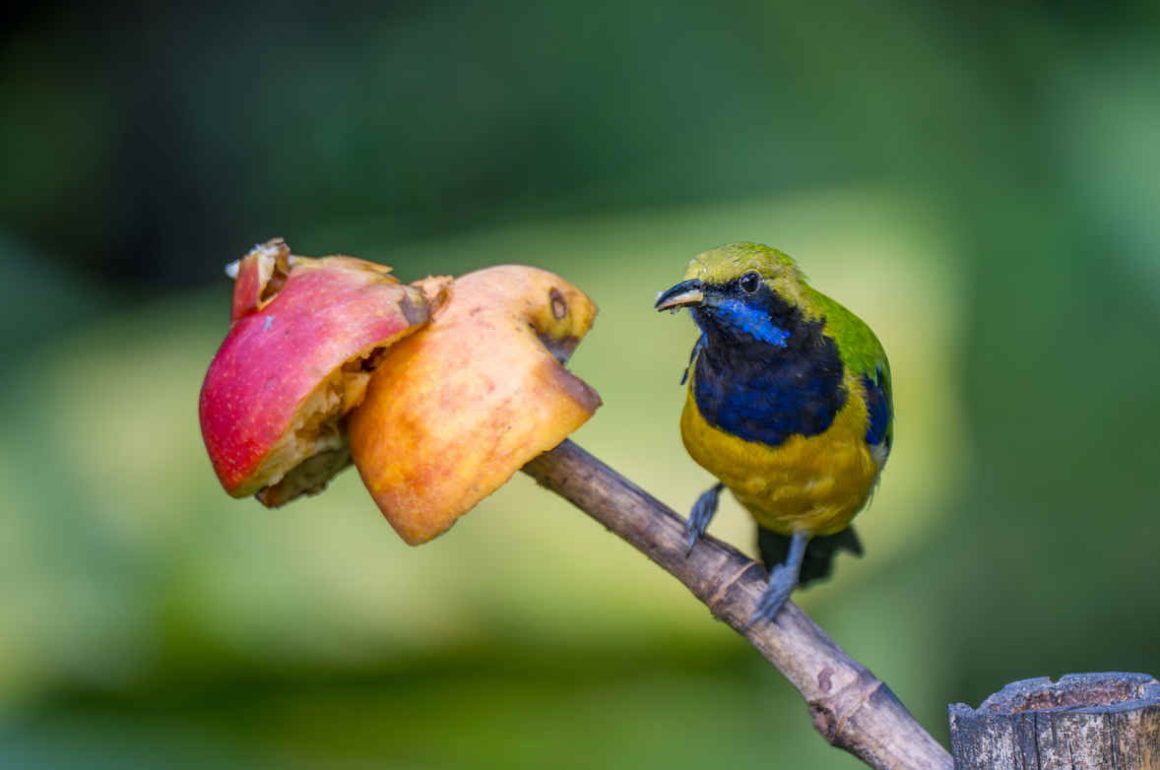
Photo: An Orange-bellied Leafbird enjoying food …









This is a great post with humbling advice. Patience is most often mentioned. Reading each guides’ suggestions made me aware of my own transgressions. I loved Savio Fonseca’s comments; first because they are so true and second because they reminded me of my 2023 birding trip to India and birding with non-birders. Oh, so true and even worse. Try to avoid birding with non-birders if you can. As in my case, sometimes it may not be possible.
I would also like to comment on “Using their ears more often” from Tom in Australia. I love hearing bird sounds, but in the past 5 years or so I have learned that my hearing is not what it used to be. This is very likely the case for many birders. This is perhaps when a guide needs to be patient. More can be written about this, but not here.
To this I might also remind, especially guides but even fellow birders, that no two birders vision is the same. I have long observed that those who are far-sighted are able to find and see birds more readily and easily. Those who are near-sighted, a different story. And then there are those like me who wear bifocals and even my corrected far vision is not great. At the beginning of a trip, I will often speak with the guide about this. However, it might take a tiny bit longer, but I always see the bird.