

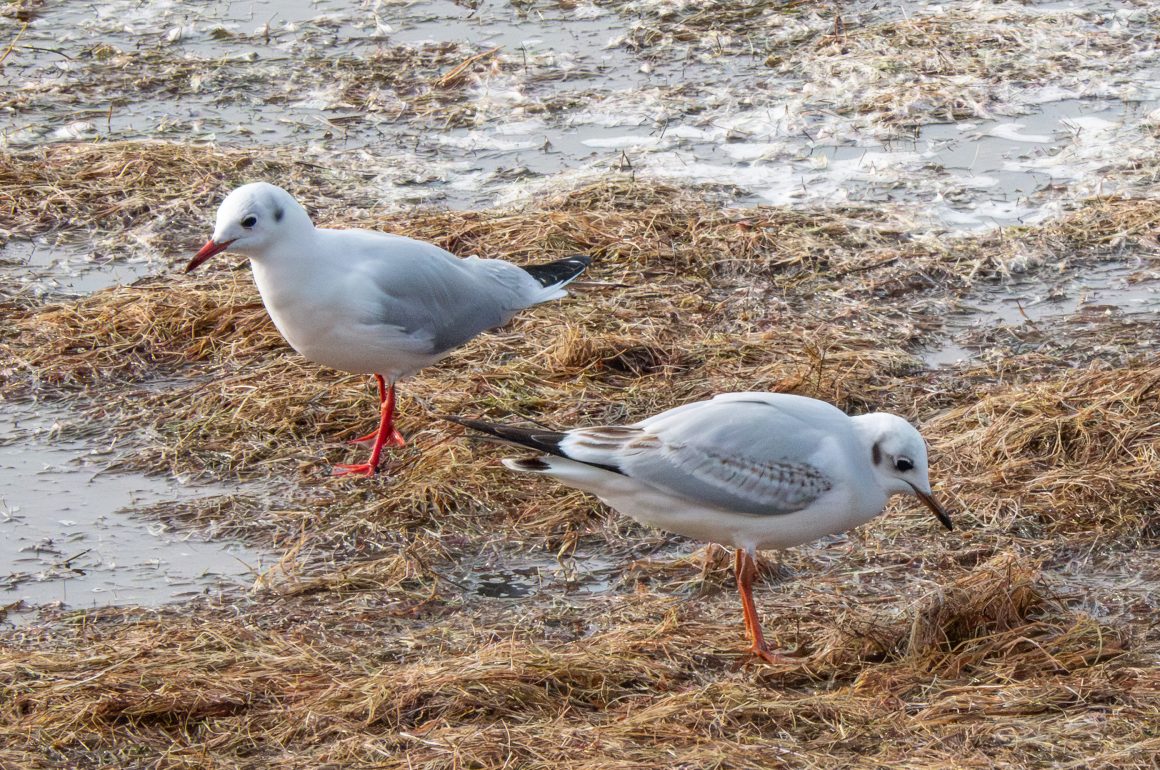
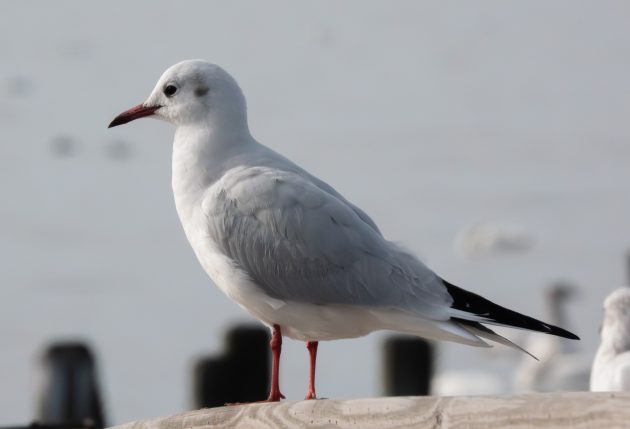
Black-headed Gull (Chroicocephalus ridibundus)
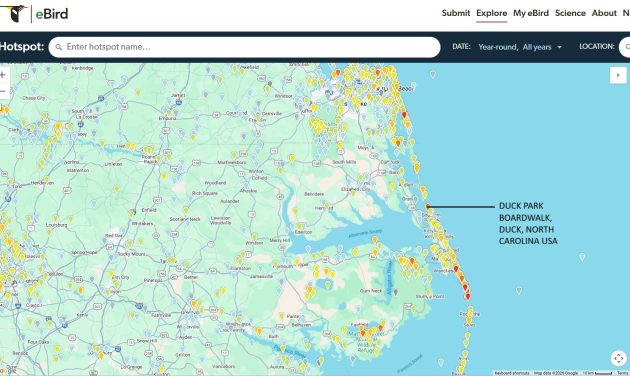
The new year brought a couple of surprise visitors to the chilly waters around the Duck Park Boardwalk of my home patch in Duck, North Carolina. First sighted in late December, these two Black-head Gulls hung around with a gang of Bonaparte’s Gulls over the Christmas and New Year’s holidays. It was nice of them, as it gave many non-local birders the chance to drive east to the northern Outer Banks barrier islands chain of North Carolina, to the town of Duck, to see them. There is no public transport to get to Duck or anywhere really in eastern North Carolina (it is the USA, of course).
Black-headed Gulls are not common here. According to eBird, “Rare but regular vagrant to North America, especially in the northeast, where usually seen singly among flocks of Bonaparte’s or Ring-billed Gulls. Compared to nonbreeding Bonaparte’s, note Black-headed’s red-tipped bill, dark red legs, and more extensive black in underwings.” Well, here we are with our “regular vagrant” right on cue! I have seen a Black-headed Gull come to our Dare County area, but they have never been reported in Duck, according to the Carolina Bird Club statistics for the state and county. Consequently, it took a moment to reacquaint myself with their field marks, most telling being those red legs and red-tipped bills. In Duck, some of our common gulls are the Bonaparte’s Gulls and Laughing Gulls, which some birders can mistake depending on the time of year. We see Bonaparte’s in our winter, not in summer, so that helps. We see Laughing Gulls in the spring, summer, and fall, and they are prolific. In the winter, Laughing Gulls are far less common.
As an aside, the Laughing Gulls had their big laugh on me in my first few months as a birder. I spotted a large flock in the Walmart megastore parking lot. To me, they were exotic-looking and of course, they must be rare! I sat in the parking lot for over an hour watching them, trying to identify them with my field guide and my binoculars. I didn’t have a camera yet…much to my chagrin, after that hour, I realized that they were not rare. These were Laughing Gulls. Only now am I sharing this as it’s funny to me, but at the time, I was too embarrassed to tell anybody.
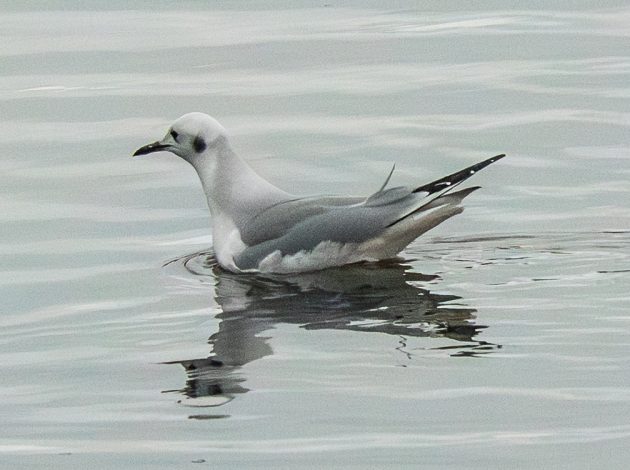
Bonaparte’s Gull (Larus philadelphia)
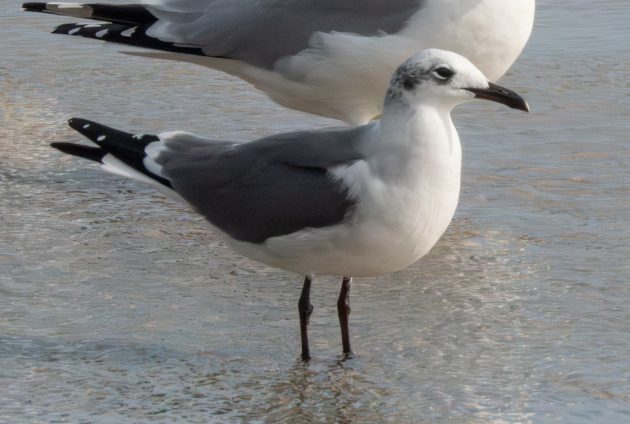
Laughing Gull (Larus atricilla)
But back to the Black-headed Gulls. Every day, birders from different parts of the state and from the surrounding states were reporting the pair in Duck. Sometimes, only one, the adult, would be seen. The juvenile seemed better at hiding out with the Bonaparte’s than its adult buddy. I would walk the boardwalk and meet new birders looking for them. Some were excited because it would be a lifer! Yes, lifers thrill me too, and I would help locate them. Other birders had seen one before somewhere else, in Europe or Asia or even in the western part of the county at the refuge at another time. Nevertheless, they were here to get it for their 2025 year bird list or their new 2026 year bird list. While I offered the latest sighting location, trying to be helpful, the local birder landmarks didn’t always help non-locals, so explaining where this or that place was as hard as pointing out a bird in the tree or bush to your birding pal. Then I would suggest a local lunch place to help our local economy in the tourist off-season. We do have good food for humans in Duck, too. For me, seeing so many birders coming to Duck in winter was a thrill and a rarity.







I still can’t tell gull species apart!
It’s wonderful to read about black-headed gulls as rarities: here in England they are our most abundant gull, and it’s not unusual to see flocks of thousands when they gather to roost. Of course, we get really excited by laughing gulls and Bonaparte’s gulls, both of which are real rarities this side of the Atlantic.
It looks to me like it would take real talent to tell those Black-headed Gulls from the Bonapartes. Our Christmas Bird Count here in central Mexico yielded our state’s second Lesser Black-backed Gull (yes, David, those are rare here), and an American Herring Gull. But I would never have picked them out of a lineup without the help of an ornithologist friend who specializes in beach birds.
Very nice article, Mary Alice! Like many others, I added this species to my 2025 and 2026 “year lists.” Running into, and giving directions to, several other birders from various distances and states that were looking for the same birds was part of the fun. I even found a few friends that I had not seen for years!
My reaction was like David’s – initially I even thought “rare” as in “undercooked” but that’s just me…
Meanwhile, on the other side of the Atlantic, I had a small flock of Black-headed Gulls feeding on the playing fields of my local park in London yesterday. They are also winter visitors. Whilst Bonaparte’s Gull is rare, although an individual has been returning for a short late Summer vacation along the Thames Estuary each year, likely since 2012, as the Black-headed Gulls it’s joined move south. I don’t get to see Laughing Gulls often, so a recent visit to Cape May distracted me while I ate my restaurant lunch. I’m sorry to say the Black-headed Gull’s didn’t get much attention yesterday once I’d checked them for Mediterranean Gulls.