
By Zhang Lin. Zhang Lin can be reached here or here.
In A Field Guide to Birds of Malaysia including Sabah and Sarawak, by Yong Dingli etc, the first of Key Birding Sites (on page 372) is Ulu Muda Forest Complex. It’s located on the border with Thailand. There’s a lodge to stay called Earth Lodge, managed by the conservationist Hymeir. It’s the first (currently the only) lodge listed on 10000birds.com.
After spending the Chinese New Year in Kuala Lumpur and Penang, we did a 3D2N package tour led by Hymeir and team. The package can be booked via their website.
Hymeir says we were the first Chinese group of birders visiting Earth Lodge. What an honor!
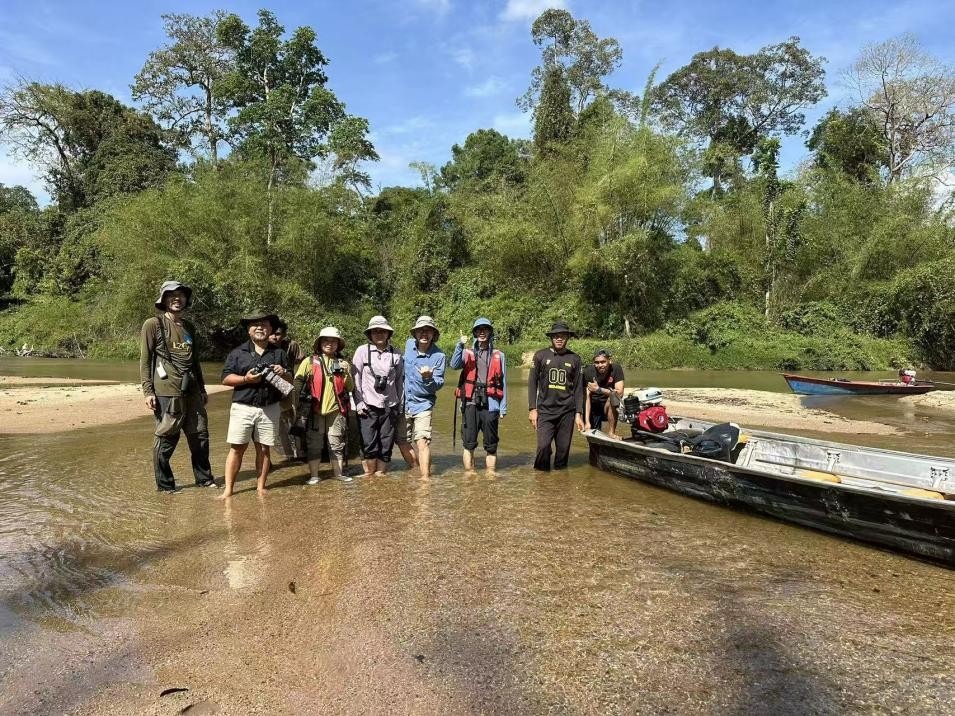
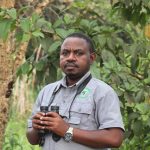
We started from Penang and followed Google Navigation to arrive at Muda Jetty at noon without any problem. Hymeir was easily recognisable as he wore the T-shirt of Earth Lodge. He locked our big suitcases in his pickup. We carried small bags and gear on two small boats and started toward the lodge. The water level is often low, so the lighter we travel, the less chance we get stuck. There are many rules here that you can read on their website. The Rule now is that if we do get stuck and the boatman has difficulty pushing the boat out by himself, wives need to jump over and help to push. Thus, I volunteered to be a wife.
The journey at first went through a reservoir and then along a river. This is the river where we would do our boat trips in the next one and a half days. After about an hour’s travel, we arrived at the lodge, and the cook started to prepare lunch for us. Even though it was at noon, bird activities were not low. Great Argus could be heard- Oh Wow -as in an emoji in Wechat, an APP popular in China, and can often be used for payment in Penang! Note that there’s no cellphone or internet connection here. Even at Muda Jetty, the signal is quite weak, and it took a while to send a WeChat message. Almost all the cost is included in the package. But at the lodge(not the jetty) you can buy a T-shirt (the same that Hymeir wore), of course not by Wechat. Cash only.
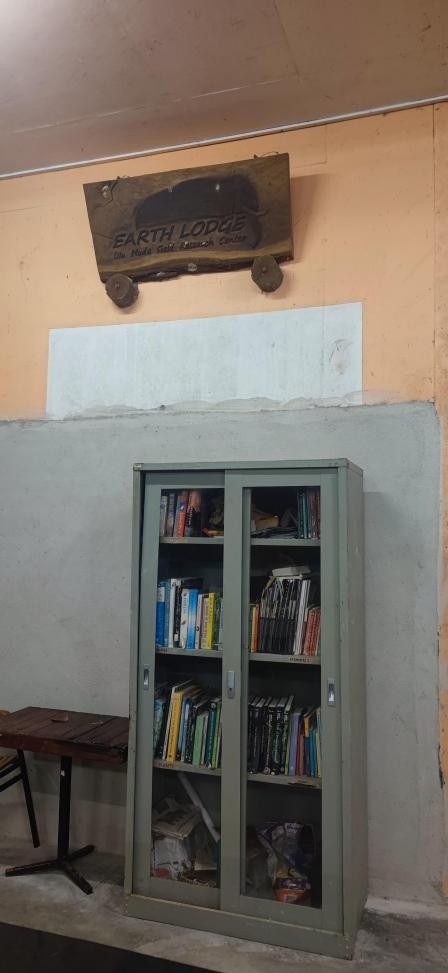
Earth Lodge’s bookshelf has many nature guides. There’s a sign of free wifi next to it, and of course, no free internet. You need to prepare your field guides, etc., in your phone or rely on printed copies.
The meals are basic and very Asian, mainly rice and rice noodles every day, which we Chinese enjoyed very much. Lots of watermelon!
After lunch, Hymeir gave us a briefing. Muda Lake and another two reservoirs in the same catchment area supply water to the paddyfields near the west coast of Kedah, which produces 50% or even 100% of the rice for Malaysia; there’s a recently described crab species named Phricotelphusa hymeiri in honor of hymeir…
Then we took a break in the room/dorms. The rooms have two beds and a bathroom. The dorms have six simple beds but two bathrooms. It was not the high season, so my roommate and I could have three beds and one bathroom each! All of them are well-maintained, and I didn’t see any rats or cockroaches during our stay, which I often see in cities. Electricity supply only lasts for a few hours from 7 pm to 12 pm. The fan won’t work after that. So I left the windows open all day and night. It was a bit cool at this time of year, so I had to use the sleeping bag provided by the lodge. I didn’t have any problem with mosquitoes, but the others said there were a few. Thanks to my roommate, who probably attracted them.
In the late afternoon, we took the two boats to row down the river slowly for birding. As the engines were shut off, we often got very close to birds such as kingfishers and mammals such as monkeys. Hymeir took us to a small lake on the bank. Sometimes elephants are seen here, and it’s the spot Hymeir’s team counts Plain-pouched Hornbills at summertime when they fly to roost. The highest count was 2200+! At this time of year, we didn’t see any Plain-pouched, but saw three Wreathed Hornbills.
Then we moved on, but soon we stopped as there was a big flock of elephants feeding. We landed on the other side of the river to watch them from a distance. I heard the call of a Dusky Eagle Owl, so I let the others walk closer to the elephant, and I tried to find out where the owl was. But soon I found that Hymeir was showing them a nest of the owl!
It was getting dark. A pair of Rhinoceros Hornbills landed in a big tree, but it was difficult to see details now. So we were on our way back with the engines on. Bats were out, and a Bat Hawk was out too. It flew over us, caught a bat, and flew back to the forest. Then Hymeir’s boat stopped. We caught up and saw the reason–another flock of elephants crossing the river! Our boatman shut the engine, but everytime he did it, the engine gave a blow which irritated the elephants now. Probably the leading elephant got angry and called very loud, to let the last few hurry up, I guess.
It was really dark now, so I turned on my torch to allow the boatman to find his way better. Dinner was ready. The Rule now is not to leave any food to attract animals. Leave it to the lodge team.
After dinner, we did a little night spotting around the houses, but didn’t see or hear much. Only one Blue-winged Pitta roosted in a tree in front of the houses. A Collared Scops Owl called, but we couldn’t see it.
We went to the rooms to charge batteries, took a shower, and went to bed. Geckos called outside.
Great Argus called again, now together with Blyth’s Frogmouth and Collared Scops Owl. In southern Thailand, I once went to a hide to see the male Argus displaying. The hide faces a small piece of open ground in the forest where one male displays to a visiting female. We needed to hike to the hide long before dawn and could hear the male starting to call at about 4 am. So I estimated it to be 4 am and got up to do a morning walk. But I found that it was only 2 am! I walked around the houses but still couldn’t see the owl or the frogmouth, although I found a turtle roosting on a dead branch in the water.
The sky was clear, and the Dipper was very low above the horizon. The polar star was totally blocked by trees, which indicates our low latitude.
It was 4 am now. The pitta was still roosting there, and I went back to bed. I woke up again at 6:45, ready to have breakfast at 7 am, and found that the pitta was still there. After breakfast, it was bright, and it left. Of course, the arguses were still now and then calling. We started to hike along a trail behind the houses toward a limestone cave. It was unusual to have a cave like that in this area, so the recently discovered cave complex supports a unique ecosystem. The trail is 4.4 km one way, with difficulty easy or normal. Hymeir knows some Chinese don’t like many 4s, so he claims it to be 4.5km. Morning has many birds calling, but along a trail in a tropical forest, it’s always difficult to see them. We heard hornbills calling loudly just overhead, but could hardly see any. We were once under an Agile Gibbon singing with hornbills in the same tree. Only when it decided to swing away did we see it briefly (or I saw it as I ran to follow it to get a few glimpses). We walked generally fast without many stops for birding, so that we could reach the cave and get back to the lodge around 2 or 3 pm.
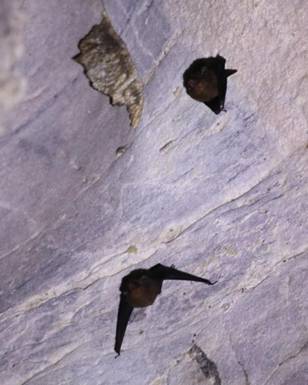
The cave is small. There are marked trails, and we walked just along them to avoid disturbing the floor of the cave and the bats roosting deep inside the feeder caves. We found some snail shells, probably brought in by a thrush to break on a rock. There were also many leftovers by Lesser Asian False-vampire, including bird feathers, millipedes, etc. We also saw spiders, toads, and the skin shed by a snake?Elaphe taeniurus ridleyi ?.
Our team had several walkie-talkies to keep in contact, but one of the boatmen followed us all the way. Only on our way back, we stopped at the side of a creek, and we realised he carried our lunch, the fried rice packs, and apples from northern China. The lodge provides leech socks for us, but he didn’t wear any. At this time of year(dry season), if you don’t get far from the trail, you hardly meet any leeches.
Earth Lodge suggests guests bring a 1L water bottle to refill at the lodge. Almost all of us drank up the 1L of water. When getting back to the lodge, orange juice with ice was ready!
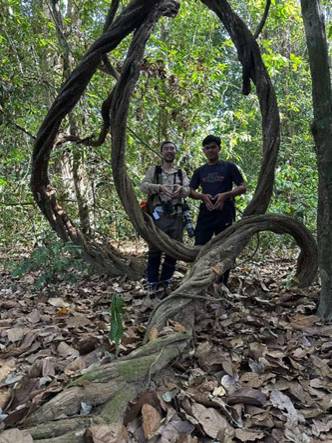
Soon after, we took a 5min boat ride upstream to a sira (salt lick) with a hot spring. A member of our group wanted to swim, so I suggested that he swim where the hot spring water flows into the river. He felt it was too hot, so we just walked to the sira. Sometimes elephants visit the sira in the daytime, so we must keep quiet. Good enough, we didn’t meet any elephant, just many Thick-billed Green Pigeon. Lots of prints on the ground, though. There’s a kind of bacteria of a whitish color swimming in the hot water. Nearby, we found a few pellets and droppings of a bird. The pellets contained mainly fish bones, so they were probably from a kingfisher.
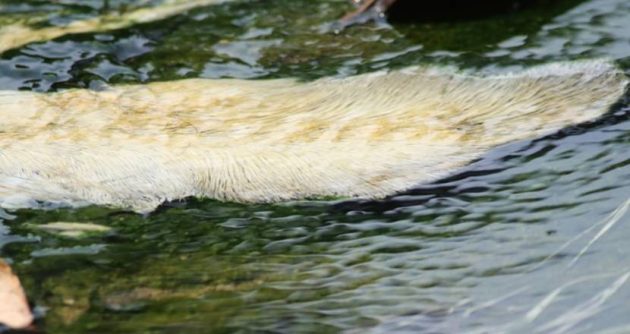
Back at the lodge, the guy decided to swim in the now cooler river. But it was too cool, and very shallow!
Today we decided to do the river cruise again, but earlier so that we could see the nesting Dusky Eagle Owl better and didn’t have to find our way in the darkness. When we got onto the boats, two Blue-winged Pittas landed and hopped on the dry sand in the creek (btw, there were footprints of a big cat in the sand, but might be from quite a while ago, as the water level had been low for a long time). At the same spot near the nest, we saw a flock of elephants, probably the same flock we saw yesterday. On the way back, since we came earlier, bats were probably less active yet, and we didn’t see the Bat Hawk. We met another flock of elephants crossing the river at the same spot.
After dinner, we did night spotting again. Two Brown Boobooks were calling, one on our side and one on the other side of the creek. We didn’t use playback, and the one on the other side flew to a dead branch on our side, and we had a good view. The Blue-winged Pitta chose another spot to roost, and we couldn’t find it anymore. The turtle still roosted at the same spot, but in the early evening, it didn’t sleep fast and dropped into the water when we shed a torchlight on it.
After a full day of activity, we slept well and woke up at 5 am due to the frogmouth. So we went out night spotting, but we still couldn’t see it. The turtle was now fast asleep and didn’t care about our torchlight at all. The stars were blinking, but far away on the horizon, there must be lightning. At breakfast time, a few raindrops fell. We did the last river cruise, packed, and got back to Muda Jetty at noon.
Here are some animals, etc., in our trip(I don’t know plants at all).
Birds:
RED JUNGLEFOWL Gallus gallus
GREAT ARGUS Argusianus argus
Thick-billed Green-Pigeon Treron curvirostra
Mountain Imperial-Pigeon Ducula badia
Greater Coucal Centropus sinensis
Banded Bay Cuckoo Cacomantis sonneratii
Blyth’s Frogmouth Batrachostomus affinis
Silver-rumped Spinetail Rhaphidura leucopygialis
Brown-backed Needletail Hirundapus giganteus
Plume-toed Swiftlet Collocalia affinis
Himalayan Swiftlet Aerodramus brevirostris
White-nest Swiftlet Aerodramus fuciphagus
House Swift Apus nipalensis
Gray-rumped Treeswift Hemiprocne longipennis
Whiskered Treeswift Hemiprocne comata
Red-wattled Lapwing Vanellus indicus
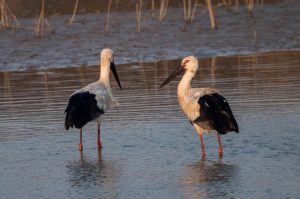
Asian Openbill Anastomus oscitans
Little Egret Egretta garzetta
Little Heron Butorides atricapilla
Pond-Heron sp Ardeola sp
Gray Heron Ardea cinerea
Osprey Pandion haliaetus
Oriental Honey-buzzard Pernis ptilorhynchus
Crested Serpent-Eagle Spilornis cheela
Changeable Hawk-Eagle Nisaetus cirrhatus
Bat Hawk Macheiramphus alcinus
Crested Goshawk Lophospiza trivirgata
White-bellied Sea-Eagle Icthyophaga leucogaster
Lesser Fish-Eagle Icthyophaga humilis
Gray-headed Fish-Eagle Icthyophaga ichthyaetus
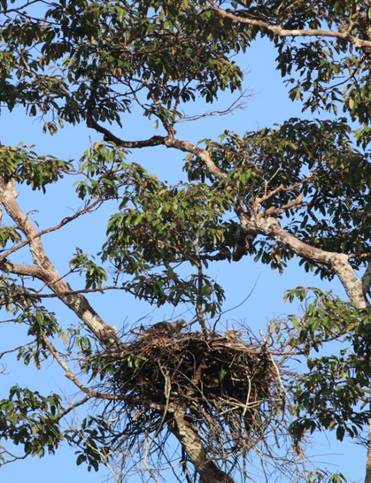
The adult with its big baby
Reddish Scops-Owl Otus rufescens
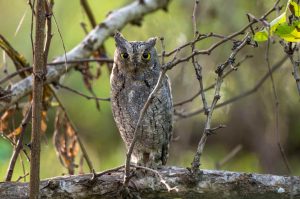
Collared Scops-Owl Otus lettia
Dusky Eagle-Owl Ketupa coromanda
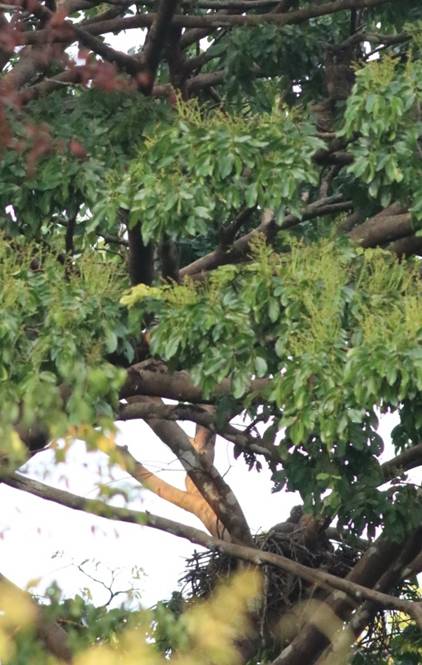
The nest is much bigger than the bird itself. Try if you can spot the adult.
Brown Boobook Ninox scutulata
Rhinoceros Hornbill Buceros rhinoceros
Oriental Pied-Hornbill Anthracoceros albirostris
Wreathed Hornbill Rhyticeros undulatus
Wrinkled Hornbill Rhabdotorrhinus corrugatus
Red-bearded Bee-eater Nyctyornis amictus
Common Kingfisher Alcedo atthis, only one along the river
Blue-eared Kingfisher Alcedo meninting
Banded Kingfisher Lacedo pulchella
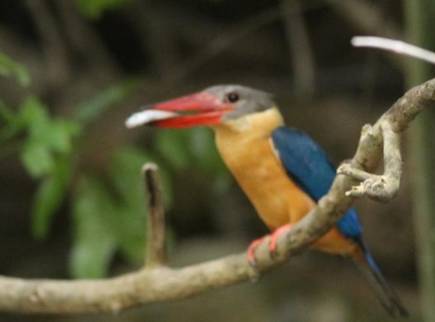
Stork-billed Kingfisher Pelargopsis capensis is much more than the Common Kingfisher
Black-capped Kingfisher Halcyon pileata
Rufous-collared Kingfisher Actenoides concretus
Dollarbird Eurystomus orientalis
Red-throated Barbet Psilopogon mystacophanos
Yellow-crowned Barbet Psilopogon henricii
Flameback sp Chrysocolaptes guttacristatus/Dinopium javanense
Crimson-winged Woodpecker Picus puniceus
Dusky Broadbill Corydon sumatranus
Black-and-red Broadbill Cymbirhynchus macrorhynchos
Black-and-yellow Broadbill Eurylaimus ochromalus
Garnet Pitta Erythropitta granatina
Blue-winged Pitta Pitta moluccensis
Brown-rumped Minivet Pericrocotus cantonensis
Large Woodshrike Tephrodornis virgatus
Black-winged Flycatcher-shrike Hemipus hirundinaceus
Crow-billed Drongo Dicrurus annectens
Greater Racket-tailed Drongo Dicrurus paradiseus
Brown Shrike Lanius cristatus
Crow sp Corvus sp
Yellow-bellied Prinia Prinia flaviventris
Pacific Swallow Hirundo javanica
Barn Swallow Hirundo rustica
Black-headed Bulbul Microtarsus melanocephalos
Black-crested Bulbul Rubigula flaviventris
Red-eyed Bulbul Pycnonotus brunneus
Eastern Crowned Warbler Phylloscopus coronatus
Chestnut-winged Babbler Cyanoderma erythropterum
Moustached Babbler Malacopteron magnirostre
White-chested Babbler Pellorneum rostratum
Hill Myna Gracula religiosa
Jungle Myna Acridotheres fuscus
Oriental Magpie-Robin Copsychus saularis
White-rumped Shama Copsychus malabaricus
Orange-bellied Flowerpecker Dicaeum trigonostigma
Asian Fairy-bluebird Irena puella
White-rumped Munia Lonchura striata
Gray Wagtail Motacilla cinerea
Mammals:
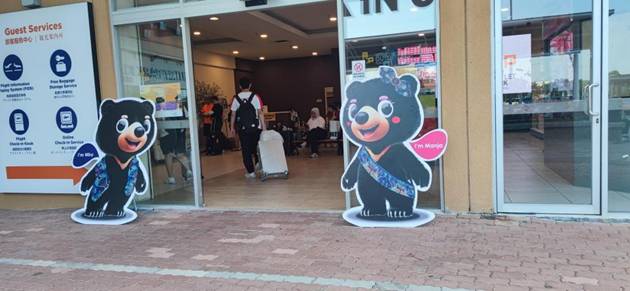
Manjia and Wira, the Sun Bears Helarctos malayanus, stand for Malaysia’s tourism in 2026, although we didn’t see them.
Asian Elephant Elephas maximus
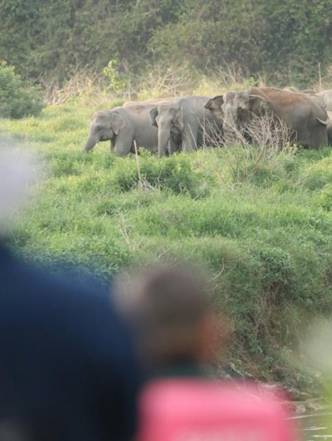
Hymeir watching elephants. The Rule here is that anyone with tusks must be blurred.
Agile Gibbon Hylobates agilis
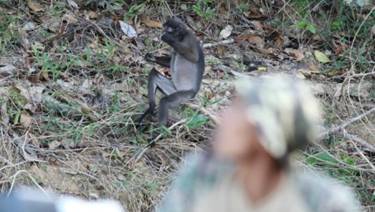
Long-tailed Macaque Macaca fascicularis
Southern Pig-tailed Macaque Macaca nemestrina
Robinson’s Banded Langur Presbytis robinsoni
Dusky Langur Trachypithecus obscurus possible hybrid with Presbytis
Lesser Asian False-vampire Megaderma spasma
Species that can be preyed upon by the Lesser Asian False-vampire
Black Giant Squirrel Ratufa bicolor
Black-striped Squirrel Callosciurus nigrovittatus or Plantain Squirrel Callosciurus notatus
Amphibians:
River Toad Phrynoidis asper
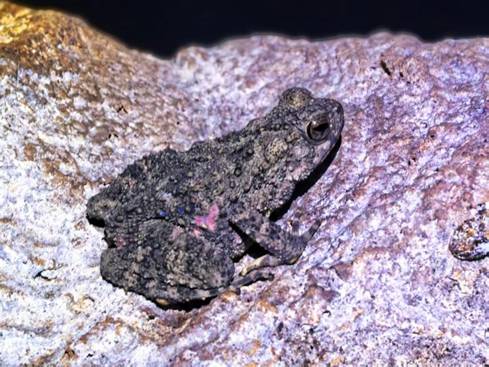
Frogs. Some around the lodge, and some very small ones near the creek, where we had packed lunch
Reptiles:
Water Monitor Varanus salvator
Tokay Gecko Gekko gecko
Green-eyed Gecko Gekko smithii
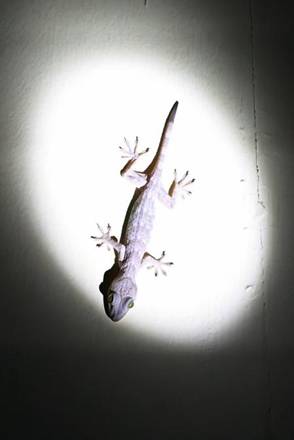
Turtle sp. probably Asian Leaf Turtle Cyclemys dentata
Fish:
Some small ones at the lodge jetty, and one caught by a Stork-billed Kingfisher
Invertebrates:
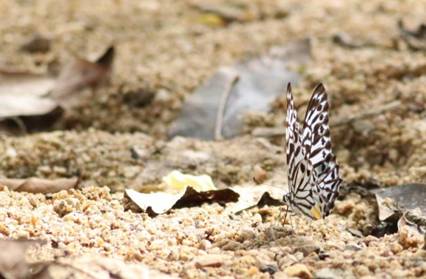
Butterflies.Several species in the creek.
Walking Stick sp..One in front of my dorm.
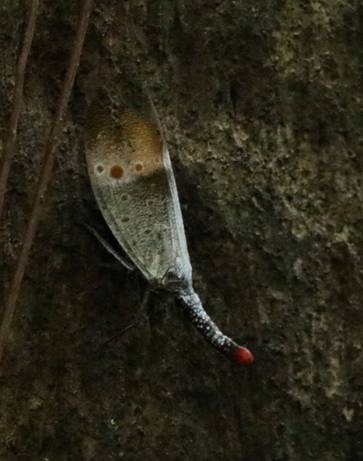
Lanternfly Pyrops pyrorhynchus
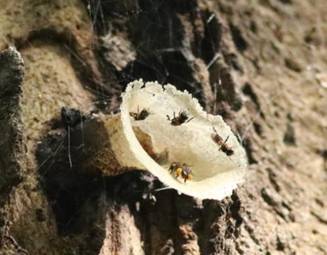
Bee sp.
Spiders:
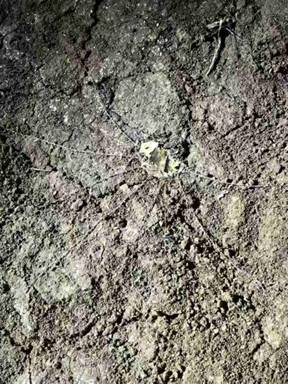
Liphistius sp
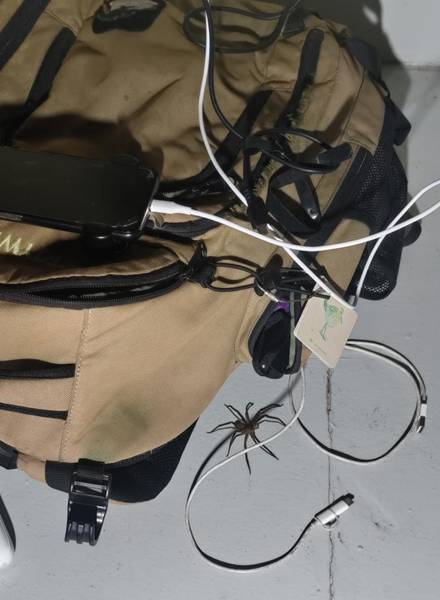
In the dorm with a tag of Spoon-billed Sandpiper in China (an NGO)





Leave a Comment