

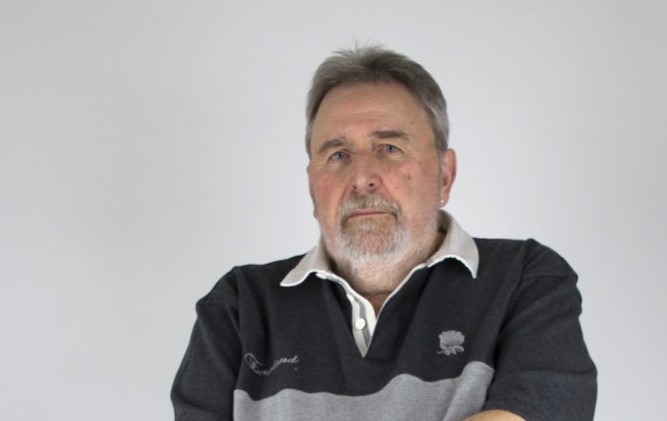
Bo Beolens is the creator of Fatbirder, a highly respected and remarkably comprehensive website covering just about every corner of the birding world. If you’ve ever typed the name of a country, a bird, or a birding topic into a search engine, chances are you’ve ended up on his site. We asked Bo a few questions about how Fatbirder came to be, how it has evolved, and what it means to run a resource that so many birders rely on.
First off, why the name Fatbirder?
I founded Fatbirder when there were fewer than a million websites worldwide, more than a quarter of a century ago. Back then, websites, or at least a lot of commercial ones, came up with funky, eye-catching names that didn’t mean much. I was, at the time, an overweight birder, and coined the name to reflect that and to imply I didn’t take myself too seriously.
If somebody asked you for a mission statement for your site, what would it be – even if, like me, you don’t really believe in mission statements?
Actually, it’s always had a mission: to bring together birders worldwide, regardless of politics, race, religion, orientation, or gender. I truly believe we have more that unites us than pushes us apart. You can’t love birds and not care about nature in general. I now have birding friends of every persuasion in almost every country in the world.
Your site is vast and covers many topics related to birds and birding. Which parts are you the most proud of? Which ones less so?
I don’t think proud is how I’d put it, but it is satisfying that all the geographical pages and bird family pages have recently been (or a few are being) completely rewritten, updated, and illustrated with thousands of first-class photos. Every link has been checked, too. This enriches the resource, and you can quickly see which birds are endemic to a location or see the latest species list in a family. The trip reports include many that are published nowhere else, too. However, this means that most of the ‘other’ pages will be a bit more ‘tired’… but I will get around to them once all the passerine families are complete.
Is there anything on the site you would probably not include if you were starting from scratch today?
I’d probably NOT link to BLOGS. The problem is that they are VERY variable. Some brilliant and some not so much, but the issue I find irritating is the number of such sites that just get abandoned. Search engines still find them even though they haven’t been updated for a decade or more. Too few people bother to remove misleading and out-of-date material.
Do you spend more time birding or working on the site these days? What’s the ratio?
Truth is, I’m lucky if I get out birding once a week! Whereas I’m working on the website a lot, every day. I’m getting long in the tooth, so I no longer travel to go birding overseas. Actually, I’ve stopped birding anywhere outside of my home county. I think most birders change… I like to see birds I’ve never seen before, but get more pleasure out of seeing new behaviour in common species, or getting new birds turning up in my tiny yard! People have lounges bigger than my yard, but I’ve had some fleeting visits from unusual birds over the years. I guess I’ve also reverted to my youth, inasmuch as I take an interest in ALL of nature, getting more into insects, wildflowers, and fungi, for example. For example, I’ve been photographing all the common frogs that have been coming to my tiny pond. So far, 26 different individuals have turned up around a bath-sized pond in my lounge-sized garden, remarkable!
Which parts of maintaining Fatbirder still feel like genuine fun – and which parts feel more like something you ought to be paid to do?
I’d love the site to pay, and ads do help cover the costs and a bit of my time… but I’ve ALWAYS seen it as a service. I set it up simply because I could not find things on the WWW that I wanted. Like species lists, country accounts, etc. I’ve always been a writer, so that remains enjoyable. Choosing which photos to use is inspiring as well. I most enjoy all the correspondence I get from birders. Mind you, most people assume I live in their neck of the woods and are often surprised to find I live in the extreme southeast of the UK (get any further southeast and you’d have a French accent).
Which aspects of running the site do people most underestimate – the time, the curation, or anything else?
It’s less underestimating the time and trouble, more overestimating the size of my ‘team’. It’s just me 🙂
Over the years, have birders become more demanding, more helpful, or just more numerous?
There are many more birders, some less helpful, others much more. The biggest growth has been in ‘toggers’. Back in the day, very few people were carrying cameras, especially the kit they do now. My son was always a birder, but is now a photographer too. The tragedy is that too many became photographers before being birders. Fieldcraft should come before everything, as should bird welfare. That’s less likely if what you want is an image, not just a sighting.
I bumped into someone the other day, drawn to a rarity. He said he wouldn’t know what it looked like if it landed in his hand… he takes photos first, then goes home and looks things up. I guess that is better than taking no further interest and just being satisfied with a good photograph. Sadly, I think that most birders, at least those that I’m aware of, are very similar to how they’ve always been – far less diverse than I would like to see. Some are incredibly helpful, of course, some less so, some are downright obstructive. I’ve been lucky enough to bump into mostly birders who want to share their joy of Birding and Love of birds. They far outnumber the grumpy ones or those who seem to find enjoyment in seeing things that other birders haven’t. That’s not an attitude I understand at all. For me, the greatest joy of Birding is to share it with others.
How do you decide which sites get linked on Fatbirder?
Early on, I decided that Fatbirder had to concentrate on birds and nothing else. I knew that if I began by including any website related to Nature or other taxa, it would soon become just too big and too generalist. I set about finding relevant links and including them on any given page. Quite quickly, I realised I needed to designate different sections on each page, and that too dictated what sort of links were made, such as to local birding clubs, or bird tour companies and guides. So my yardstick has always been – if it’s of immediate relevance to birdwatchers, then I should include it. However, I have had to exclude some birding sites which were relevant, but were either badly inaccurate or contained malicious or prejudiced information. Over the years, this process has, of course, been modified by experience and feedback from all the users about what they would find useful.
Is there a small detail on Fatbirder that almost nobody notices, but that you’re quietly pleased with?
Fatbirder has been completely rebuilt and code re-written three or four times since I first established the website. The last time this was done, I ensured that the developer was aware of, and catered to all sorts of abilities and disabilities. So, the site is as accessible as I can make it, although I’ve no idea whether it’s used in that way.
Conversely, what’s something people always notice or email you about that makes you think, “Really… this again?”
Honestly, I really can’t think of anything that occurs in that way. Obviously, sometimes people do point out an error or information that’s changed, but I pride myself on fixing those things straight away, so I don’t get repeat comments. To be honest with you, when I do get a repeat comment, it’s usually because someone needs to clear their cache – the problem has already been fixed, but they haven’t seen the correction yet.
Has running Fatbirder for so long changed your own birding – for better or for worse?
Over the years, my Birding has changed, but I don’t think it’s in response to having done Fatbirder for so long. However, creating the site has been useful to me. For instance, back in the days when I was travelling the world, having made so many contacts, made it easy for me to ask about local Birding when I was intending to take a trip, and to meet up with other local birders that way – nothing beats local knowledge.
Perhaps one thing that has changed is that I am much more aware of the science than I used to be. Drawing up lists of species, for example, not only tends to teach you a bit of Latin, if you didn’t already know it, but also alerts you to taxonomical changes. That’s something I’ve always enjoyed anyway. I’ve become much more aware of the people who went out looking for new species, naming them, and having birds named after them. That led me down some interesting alleyways. With friends, I wrote a book about people after whom birds had been named in the vernacular – their ‘common’ names. That, in turn, led me to write about the people behind the names of other taxa such as mammals, herps, odonata, etc, which in turn led me to write several more books. From a Birding point of view, the most comprehensive was the Eponym Dictionary of Birds, published over a decade ago. I also write a monthly column in ‘Birdwatching’, a British Birding magazine – the column is called The Grumpy Old Birder. I’ve been doing it now for more than 20 years, and I’m sure that, had I not set up Fatbirder, I would never have had that opportunity.
If time and money were no object, what’s the one Fatbirder-related project you would finally tackle?
Those who know me will know that I have had a form of arthritis for the last 50-plus years. Now that I’m in my eighth decade, I find it harder and harder to spend all day long on a keyboard. If I were rich beyond the dreams of avarice, I’d probably employ a team of people to do what I do. I guess that, failing that, at some stage I’ll have to look at passing the baton to a younger birder. I doubt that it would be easy to find anyone who has all the enthusiasm, but who is willing to spend most of their time at the keyboard instead of out watching birds.
And finally, is there anything you wish I had asked, but didn’t?
Before retiring, I was the director of a number of ‘people’ charities, mostly to do with disability or disadvantage. Since then, apart from working on Fatbirder and writing commitments, I’ve always been involved in some sort of voluntary organisation. Some friends and I set up ‘Birding For All’ a quarter of a century ago. Like Fatbirder, I started that up because nothing like it existed. Selfishly, I was frustrated by the lack of attention paid to access for those with disabilities to Bird reserves and other countryside wildlife activities. All this time later, while there are some reserves that are much more accessible, most are almost as bad as they were. The truth is that access needs are little understood, and where provision is made, it’s almost entirely for the benefit of wheelchair users. What most people don’t realise is that the vast majority of disabled people, or even just those with mobility issues, are not wheelchair users, but find distance a massive problem. If there were just one thing that I could do to make reserves more accessible to more people, it would be to provide simple benches every 150 m around a track. This would help very many disabled people, as well as those people pushing prams and push chairs, the elderly, the very small, etc. So, I guess that the only question I would’ve liked you to ask me would have got me riding that particular hobby horse.
I’m also very saddened by the fact that the community of Birdwatchers hasn’t really changed a huge amount in my lifetime, at least here in the UK. It still tends to be a pursuit for middle-aged and older, white men. There are not enough women taking part, and not enough people from different ethnic backgrounds. I can only conclude that this is because the community can still be quite intimidating to the uninitiated and the new birder. Kids in school are not only exposed to Nature these days, but also clearly enjoy everything from pond dipping to Nature walks to collecting natural objects. But once they leave school 99% of them leave these things behind, and that’s sad. I think we birders have the responsibility to help everyone have the chance to be up close and personal with the wild world, because almost everyone would fall in love with it just as we have.
Anyway, many thanks for giving me this opportunity to let more people know about my website. I hope that some of your readers who have never heard of it before will take a look around and enjoy the wonderful photographs that many birders share on the site, as well as the wealth of information on birds, birding, and birding places.





Another great post. I’ve used fatbirder for years and yet had no idea who was behind it and how much work it entailed. I hope Bo is able to find a protege to keep it going. Hats off to Bo.
Great interview. I do agree with Bo about benches on bird reserves, and not just because I have bad knees. It’s wonderful to just sit down and watch, something you discover as you get older. I supplied my own bench to my local reserve and get great pleasure from sitting on it and simply watching birds, usually with my dog at my feet. It’s something that I do nearly every morning before breakfast, as it’s the best way to start the day.
Yeah, those benches, I recommended the same here (also commented on the Norfolk Wildlife Trust boardwalks): https://www.10000birds.com/how-to-bird-on-crutches.htm
Would love to find a way of increasing the amount of benches on the trails through some sort of joint venture/social project. I can source plantation wood from fsc foresrs south and central america and produce them by setting up a workshop in the UK that works with disabled people.
Great accessibility is being offered in the Netherlands: https://vogelkijkhut.nl/search/?query=&province=0&features=access_wheelchair