

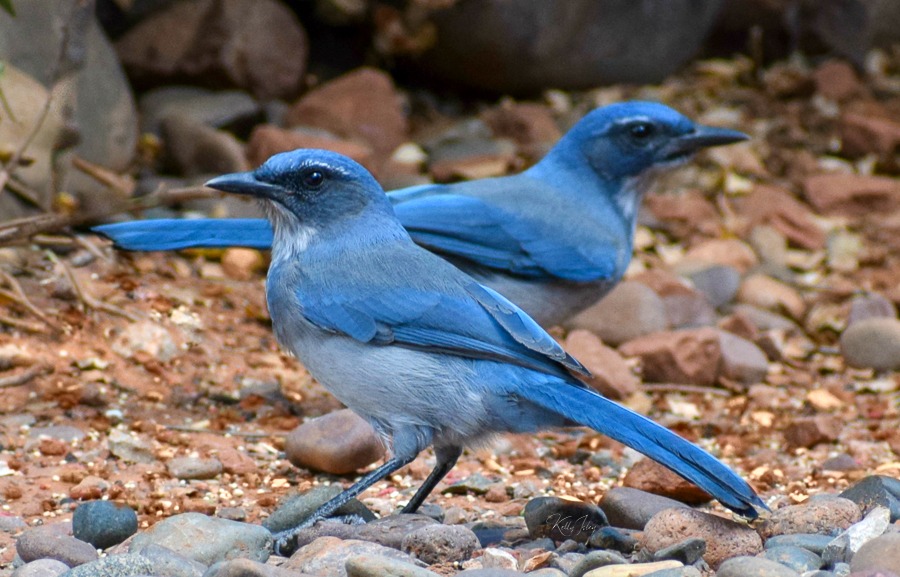
By Kelly Isley
Kelly Isley is a five-time author and wildlife photographer with an aerospace engineering background. Passionate about birds, she serves on the Northern Arizona Audubon Society board and works worldwide.
Due to shifting weather patterns and unexpected sightings, this winter offers a timely opportunity to compare two familiar corvids of northern Arizona: Woodhouse’s Scrub-Jay (Aphelocoma woodhouseii) and Steller’s Jay (Cyanocitta stelleri). Northern Arizona has incredible bird diversity due to its mosaic of pinyon-juniper woodlands, ponderosa pine forests, high-elevation mountains, and canyon systems. Although both jays are intelligent, vocal, and blue, they typically occupy different ecological niches. This winter, however, those boundaries appear to be shifting.
Woodhouse’s Scrub-Jay
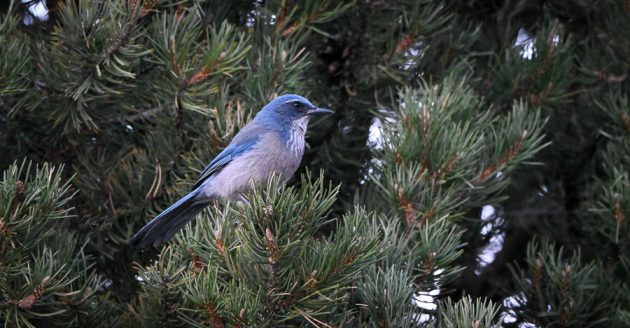
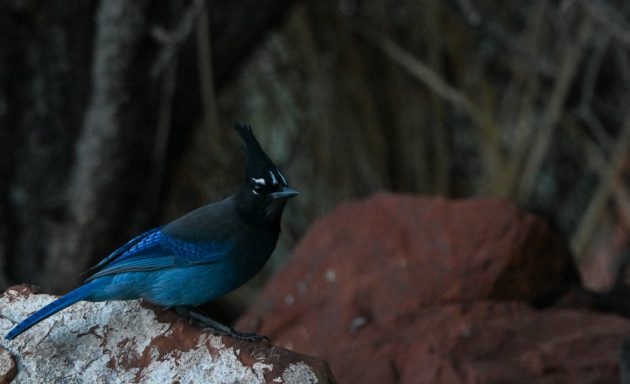
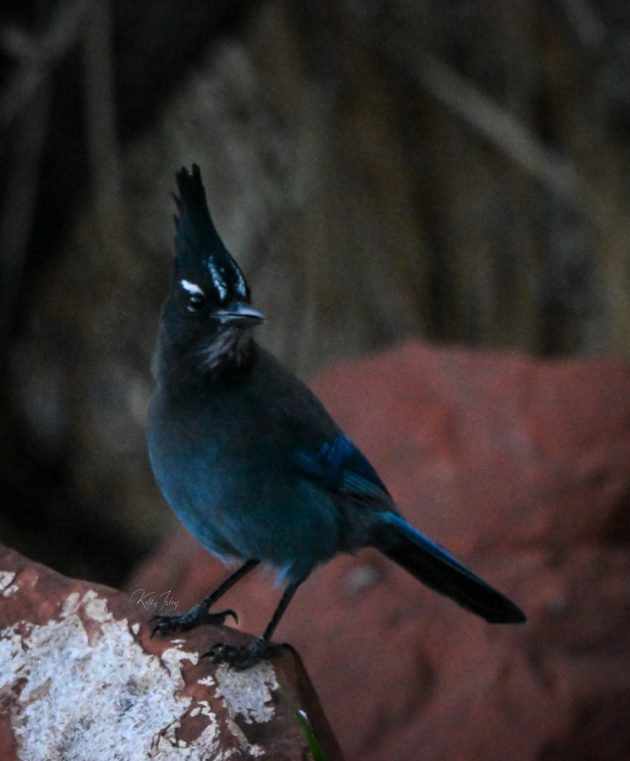
A simple way to distinguish between the two species is by appearance. Woodhouse’s Scrub-Jay has a cleaner profile with lighter blue plumage on the head, deeper blue on the wings, and its tail, paired with light gray underparts. It lacks a crest, giving it a smoother, understated look. Steller’s Jay, by contrast, is more dramatic and darker, with almost ink-blue wings and tail, a charcoal head and upper body, and a tall, expressive crest that signals alertness or agitation. The crest alone often gives it away even at a distance.
Steller’s Jay
Historically, habitat preferences in northern Arizona have been well defined. Woodhouse’s Scrub-Jay is most closely associated with lower- to mid-elevation environments, including pinyon-juniper woodlands, oak scrub, canyon rims, and desert edges. In this region, it is commonly seen around Sedona, across the Colorado Plateau, and throughout pinyon-juniper country extending toward the Grand Canyon. Its diet—pinyon seeds, acorns, insects, berries, and occasional small vertebrates—fits well with these open, shrubby landscapes.
Steller’s Jays, on the other hand, have long been considered birds of higher elevations. They are typically found in ponderosa pine forests, mixed conifer stands, and montane environments such as the San Francisco Peaks, the Mogollon Rim, and forested areas around Flagstaff. Observers often note a clear transition from Woodhouse’s Scrub-Jays to Steller’s Jays as elevation increases.
That pattern shifted noticeably this winter. Beginning in November, Steller’s Jays were reported at lower elevations around Sedona by residents, park rangers, and citizen scientists submitting observations to eBird. These sightings coincided with an early and significant snowfall in the high country. On November 20, Arizona Snowbowl opened ahead of schedule after receiving more than three feet of snow over five days. Rather than remaining in snow-covered forests, Steller’s Jays appeared to move downslope, temporarily sharing space traditionally dominated by Woodhouse’s Scrub-Jays. This behavior highlights not only the species’ adaptability but also the intelligence that defines corvids.
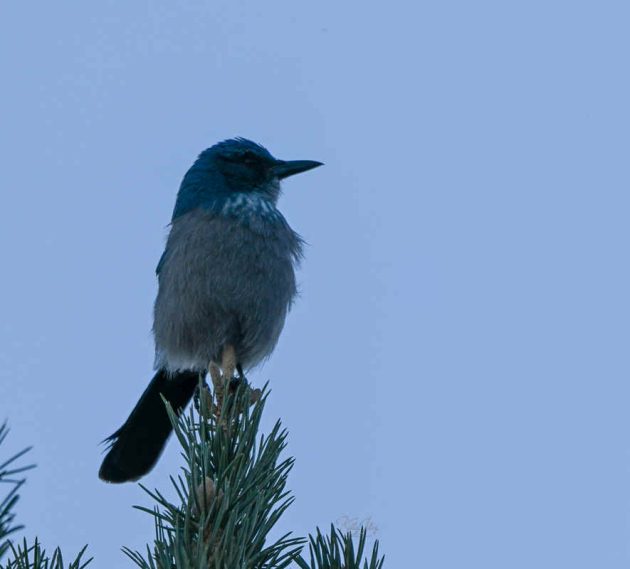
Behaviorally, the two species differ in ways that support these habitat preferences. Woodhouse’s Scrub-Jays often forage alone or in pairs, spending considerable time on the ground caching seeds for later use—an important contribution to woodland regeneration. They are alert but generally less aggressive and less noisy.
Woodhouse’s Scrub-Jay
Steller’s Jays are more social and conspicuous. They travel in small groups, vocalize frequently, and readily exploit new food sources. Their varied diet includes seeds, insects, fruit, small animals, and human-provided food, making them particularly well equipped to respond to changing conditions.
Steller’s Jay
Despite their differences, both species play vital ecological roles and serve as reliable indicators of habitat type. This winter’s low-elevation presence of Steller’s Jays near Sedona is a reminder that bird distributions are not fixed—and that even familiar species can surprise us when conditions change.
Cover photo: Woodhouse’s Scrub-Jay









A lovely, well-crafted piece. The observations feel grounded and patient, and the high-country setting gives the blue jay a fresh perspective. Kelly has a gift for turning careful watching into engaging storytelling.