

By Kendall Britt
Kendall is a resident of Central Texas. She fell in love with birds in her adulthood but has been making up for lost time. As a physician, she sees the amazing healing power that birds can bring to our lives and firmly believes that if we make the world a better place for birds, it will be a better place for human beings. Like the great Roger Tory Peterson, Kendall believes Texas is the “No. 1 Bird State”. She spends her time chasing birds from the Rio Grande to the Panhandle. When she isn’t outside with her binoculars, she can be found at home in Georgetown, TX, writing about these adventures.
As a birder, I’ve spent a lot of time in cemeteries. In fact, for birding I’d rather go to a cemetery than a park, especially in an urban setting. Parks often include baseball fields, parking lots, playgrounds, and concrete pathways-all pretty much sterile heat traps without much shelter, food, or protection. But cemeteries are free of these unfriendly habitats and can be home to many summer or year-round residents. They can also serve as a stopover for an exhausted migrant just passing through. And, as you would expect, they are generally much quieter, making it easier to appreciate the birdsong. Except if someone is mowing, of course.
I learned to bird at the IOOF Cemetery in my hometown. The International Order of Odd Fellows is a fraternal service organization that has been around since 1819. Its historical mission, according to Wikipedia, is to visit the sick, relieve the distressed, bury the dead, and educate the orphans. In so doing, they have inadvertently become a friend to birds and those who love them. One good deed begets another.
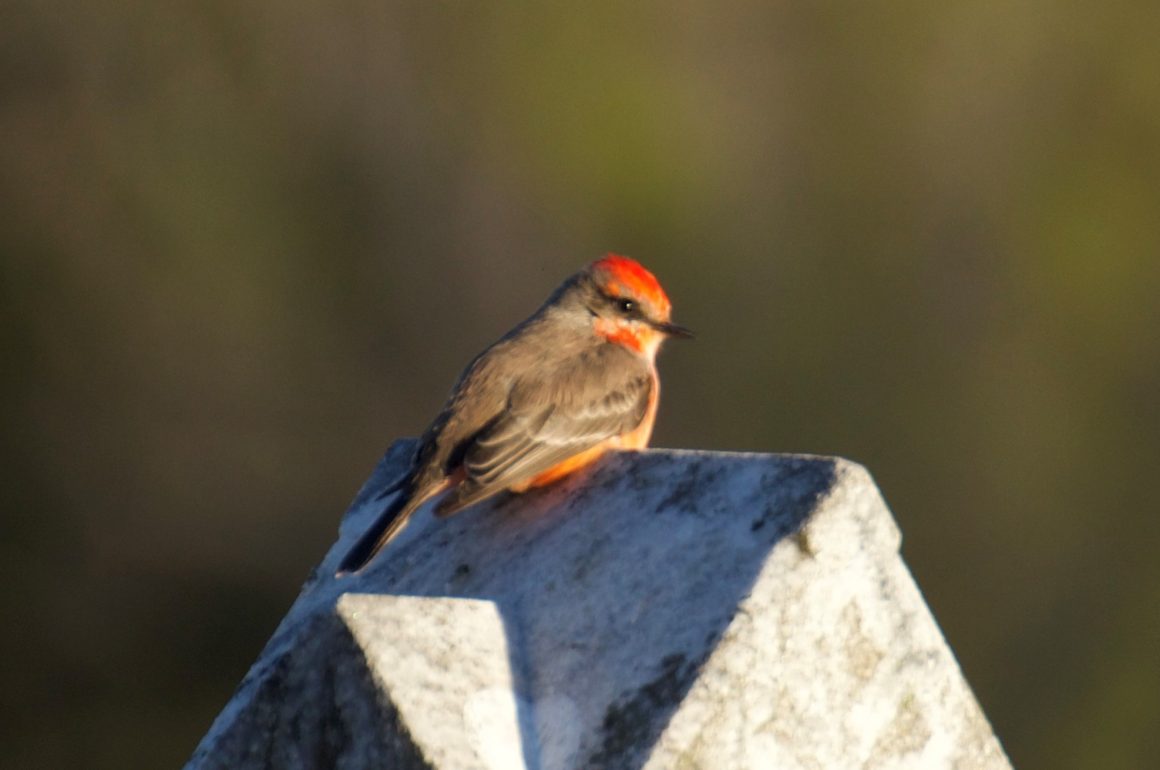
I saw my first Vermillion Flycatcher in the IOOF Cemetery. I included it on my eBird checklist and got an email from the eBird cops not too long after asking for photographic evidence. I’m not a photographer, but my daughter is, so I dragged her disgruntled self out to the cemetery and was able to satisfy our Cornell overlords with about 15pictures. Shortly afterwards, we had a deep freeze, and I never saw the little guy again. Hopefully, he flew south, ahead of the cold.
Many of my first warbler sightings occurred at Rose Hill Cemetery in Corpus Christi. The enormous live oaks were a beautiful backdrop for their colorful displays. We saw an American Redstart and several Magnolia, Chestnut-sided, and Black and White Warblers, to name a few. I’ve often taken a detour into a random cemetery while on my way to somewhere else. You never know what you might see. My first Chuck Will’s Widow was in a tiny cemetery, I’ve forgotten where.
One of my favorite graveyard experiences was in Alexander Cemetery just outside of Stratton, Texas. I learned about it from a friend. It has been her family’s grave site for generations. We stopped off on our way back from a birding trip to Port Aransas. The cemetery is surrounded on all four sides by farmland. You can’t see or hear any signs of living humans, but there were plenty of birds (Tufted Titmouse, Golden Fronted Woodpecker, Chipping and Lark Sparrows). She cleaned her parents’ graves and I wandered, looking for birds while also exploring the headstones and enjoying the history. The cemetery was established in the 1870’s so some of the graves were quite old and included freed slaves. As we left, a Bald Eagle flew overhead. Maybe it was a salute to the pioneering spirit of her ancestors? Or just another unexpected joy that birding adventures always provide.
It seems somehow very appropriate for birds to haunt our cemeteries. Many people see them as the spirit of Loved Ones who have passed on. My mother-in-law sees her husband of 50+ years in the faithful Northern Cardinal. Cemeteries are also a place of reconciliation. We are quite literally returning to the earth and can no longer escape our connection to nature. And the birds are there to witness and celebrate with song.








I agree. Cemeteries are great for birding. In Toronto, Canada, were I live, birders are now checking out the local cemeteries, looking for owls and winter finches.
In Berlin, too, cemeteries are important habitats for birds, especially for Goshawks and Common Nightingales.
As with Leslie and Rolf, I agree; cemeteries are wonderful places to bird. In my community the local bird alliance does a few walks each year in a historical cemetery here. It has an amazing list for an urban, albeit, large and very tree’d cemetery. It also has a pond which has produced a few shorebirds.
This is a lovely piece. Reads very much like a short story. I also loved your harmless pot shots at eBird. I think, at least in the U.S., we have all had this experience. Now you know, never leave home for birding without a camera. Since you a not a photographer, a hybrid digital zoom would probably serve you well. Thank you for writing this and publishing with 10,000 Birds.