
When we want an easy road trip from our base in Naples, we visit Six Mile Cypress Slough Preserve in Fort Myers, Florida. A slough (pronounced sloo) is a swampy, muddy, or marshy inlet/backwater. It is connected to a larger water body and has a slow, often seasonal, water flow.
The preserve is a 3,500-acre intermingled wetland and upland. It features an 11 mile long, 1/3 mile wide slough that acts as a wildlife corridor and filters the rainwater that flows towards Estero Bay. The slough’s appearance changes with the seasons from dry (October to May) to wet (June to September).
There is a 1.2 mile boardwalk that takes you into the preserve. It is an interesting, easy walk for the non-birders and children you bring along. Animals like alligators, turtles, otters, and waders make the slough their year-round home. Of interest to birders is that the slough is a rest stop and feeding area for migratory birds.

Little-blue Heron
On our most recent visit, we noticed the impact to the slough of the drought conditions occurring in SW Florida this year. Many areas that usually had water were either muddy or dry. But, spring was still happening at the slough. We saw blooming air plants, the Bald Cypress trees were turning green, and there were wild Iris flowering in the mud.

Barred Owl with fledgling
In past visits, it has been birdier there. We have seen an Eastern Screech Owl, sitting in its roost hole. Another time, an adult Barred Owl was perched near its fledgling. But, we still tallied 35 species during our two-hour ramble on the boardwalk. We had Tufted Titmouse, calling to each other across a pond. There were Yellow-bellied Sapsucker, Red-bellied Woodpecker, and Pileated Woodpecker.

Tufted Titmouse
Limpkins screamed their calls in the pond areas. (I identified them for the non-birders in the area, because I could see them trying to find out what made all that racket.) Waders like Great Blue Heron, Little-blue Heron, and Snowy Egret probed the water for fish.

Limpkin
We didn’t see a lot of songbird migrants. However, the Northern Parula were singing and Palm Warbler searched for insects in the bushes. Great-crested Flycatcher and Eastern Phoebe gave their distinctive calls, announcing their presence.
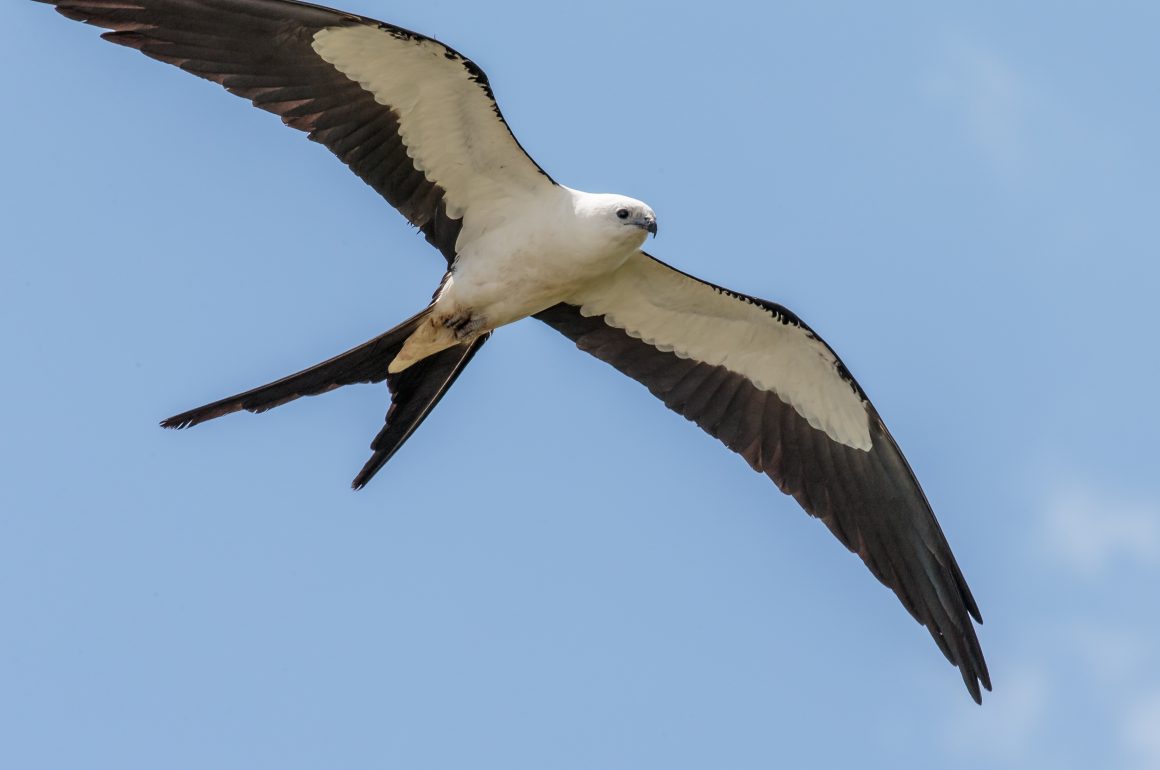
High overhead, a Swallow-tailed Kite made delicate maneuvers against the clouds. It was joined by an Osprey and a Short-tailed Hawk.
In past visits, non-avian sightings have included butterflies, alligators, snakes, and river otter.
We spent two hours there, which makes it an ideal way to spend your morning before you board a flight home from the nearby airport.
Note: All photos are from Wikipedia Commons, an online source of copyright-free photos: Barred Owl by Wildreturn; Little-blue Heron by James St. John; Tufted Titmouse by Rhododendrites; Limpkin by Gary Leavens; Swallow-tailed Kite (top of article) by Andy Morffew.


Every time I read your posts I’m inspired to visit Florida! A Swallow Tail Kite sighting is always magical. Thank you!