

Highlights
Rudong is a coastal county in Nantong, Jiangsu, China. It has vast intertidal mudflats which support a large portion of the migratory waterbirds in the East Asian-Australasian Flyway incl. some of the most endangered such as Spoon-billed Sandpiper (CR), Chinese Crested Tern (CR), Nordmann’s Greenshank (EN), Siberian Sand Plover (EN), Far Eastern Curlew (EN), Great Knot (EN), Dalmatian Pelican (NT). Some of the recent counts exceed certain species population estimates (flyway or global, as some are the flyway’s endemic).
Key Bird Species and Families
Migratory birds: Many of them fly over the Yellow Sea and reach the intertidal mudflats and the seawalls nearby. The intertidal mudflats provide feeding and roosting opportunities for waterbirds. Trees and bushes along the seawall and farmlands inside the seawall are good shelters for other migratory groups of birds.
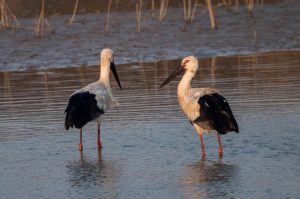
Breeding birds: Tall trees and bushes around towns and villages are the breeding habitats for summer breeders such as Black-naped Oriole, Cuckoos, Red Turtle Dove, Black Drongo, Brown Shrike, Manchurian Bush Warbler, Oriental Reed Warbler, Lesser Coucal, Chestnut-eared Bunting, Grey-headed Lapwing, and residents such as parrotbills, starlings, magpies, Meadow Bunting, and Oriental Stork.
In large open areas, you may find Saunders’s Gull, Common Tern, Little Tern, Oystercatcher, Pied Avocet, Black-winged Stilt, Oriental Pratincole, Oriental Skylark, etc breeding.
Oversummering: Some immature individuals choose not to go to the breeding grounds but stay here to spend the summer in small numbers. These include waterbirds such as Spoon-billed Sandpiper, Black-faced Spoonbill, and non-waterbirds such as Pied Harrier.
Wintering: Only a few species of waders remain in winter. Highlight is thousands of Oystercatchers, especially at Dongling. Before the cordgrass invasion, they stayed on the mudflat at high tide. East of the Dongling mark, the reclamation created some very large ponds for feeding jellyfish. In winter, the water level in those ponds is very low. When cordgrass covered most of the mudflat close to seawalls, Oystercatchers roosted in the jellyfish ponds. Now, without cordgrass, they roost again mainly on the mudflat, but the jellyfish ponds still support tens of thousands of Coots and many ducks esp. diving ones. The number of Greater Scaup can sometimes reach 3000, and small numbers of Long-tailed Duck, Stejneger’s Scoter, etc. are regularly seen.
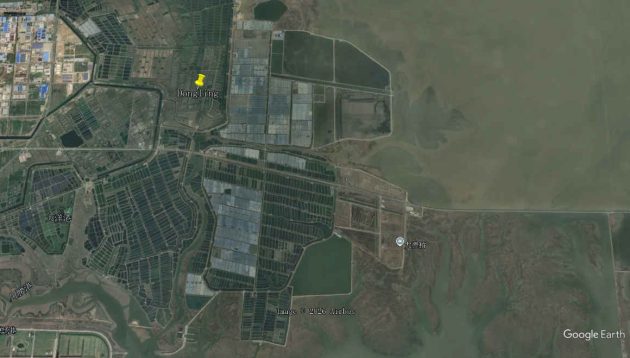
Breeding Saunders’s Gulls probably all move to south China for winter, but the northern breeding populations come down here together with other wintering gulls. A few imm. Relict Gulls are more often seen at Dongling than at Yangkou and Jianggang.
The farmland inside the seawall of Jianggang attracts many geese. A recent new record for the province is a Cackling Goose. One or two families of Red-crowned Crane chose to stay in recent winters.
Fangtang Rivermouth (the one with three maps showing the change of cordgrass cover) is the most important staging site for Dalmatian Pelican. The East Asian population is very small, and a single count of 110+ in autumn exceeds the population estimate by then. Nowadays, a few regularly winter here.
Large raptors such as White-tailed Eagle and Cinereous Vulture are very rare in this so-far-south area, but surprisingly, one imm. Steller’s Eagle stayed for a whole winter at Jianggang and is the only record for the province. It’s also the species’ southernmost wintering record.
In total, about 400 species of birds have been recorded since I found the importance of it for the Spoon-billed Sandpiper in 2008. In extensive observations, there’s nearly no report of the Streaked Reed Warbler, and in my opinion, it should have been uplisted long ago. Finally, it was uplisted as CR in 2022. The only possible sighting was from May,2019, when a singing small warbler in the reed was recorded but could not be seen well.
Population Trends for Key Species
It’s difficult to estimate the numbers and trends of landbirds, but it’s easier to do so on those waders in open habitats. The population changes are probably mainly due to habitat changes. Here are some counts by Zhang Lin and friends from NGOs.
- Spoon-billed Sandpiper: Declining. 100+ on any single day in autumn at Yangkou around 2010; now only one at any single day in autumn at Yangkou.
- Nordmann’s Greenshank: Stable. Around 1500 in those three towns. Jianggang supports 1000+.
- Common species are generally in decline.
- Eurasian Curlew: 10000- at Jianggang in autumn around 2014, when the last seawall was built. 2000~3000 regularly nowadays.
- Grey Plover: 4000~5000 wintering or in passage at any single site, but now usually 1000~2000.
Best Regions for Birding
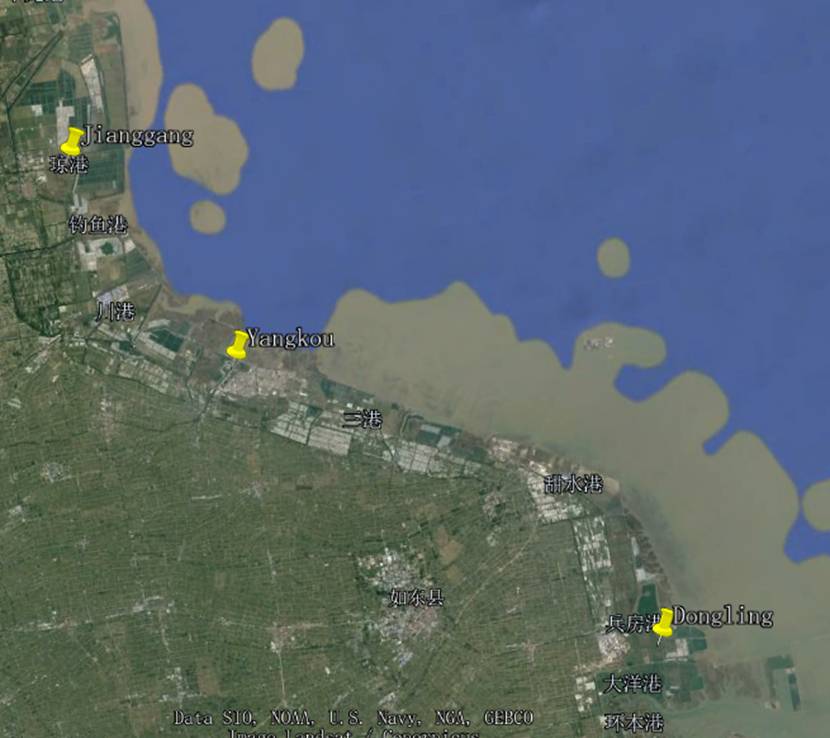
The birding concept of Rudong covers three major coastal towns: Jianggang in the north (in Yancheng), Yangkou Fishing Harbor (Yangkou for short) in the middle, and Dongling in the south. Jianggang became a part of the Yancheng Yellow Sea World Heritage in 2019. Yangkou and Dongling in Nantong decided not to join the World Heritage, and currently, there’s no effective protection.
Best Birding Season
The Spoon-billed Sandpiper migrates through the region in April and again – for a longer period – from August to October. April to November will be the months with the best chance of seeing waders.
Birding Trip Suggestion(s) and Practical Tips
- Transport: 2~4h drive from Shanghai, a major city where Zhang Lin lives. 1h drive from the railway stations and airports in the Nantong area. Seawalls are several km from the three major towns. Birding by foot is possible, but by car is better.
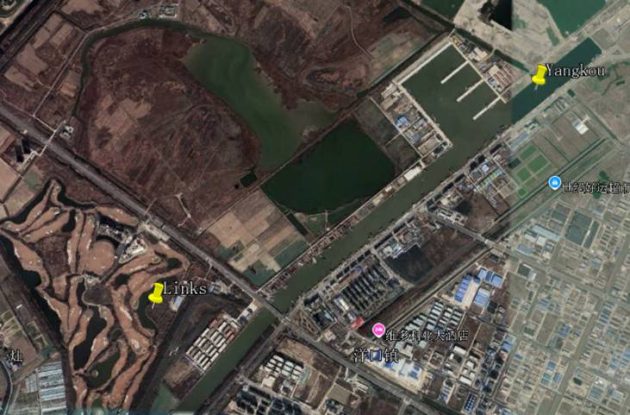
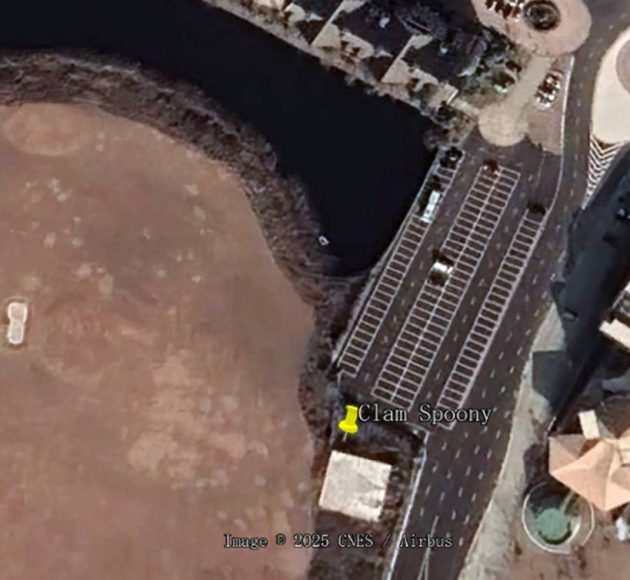
- Accommodation: Foreigners have no problem finding many hotels in Jianggang and Yangkou.The most expensive (indicated by the yellow “Links”) one is at Yangkou, with a golf course (“Links Golf & Spa”). The hotel supports our NGO, the Spoon-billed Sandpiper in China’s local conservation effort. A 15m X 15m huge Spoon-billed Sandpiper made from thousands of clam shells collected from the mudflat was finished by students from Rudong and erected in front of the hotel.
The clam Spoony. No need to zoom in anymore. You can’t see the individual clams. You have to go there to witness
- Currently, the hotels at Dongling are not so happy with foreigners. So it’s better to stay at Tongzhou Bay in the south. Tongzhou Bay is where you see those huge reclamation areas, and thus is not good for birding. It’s better to drive to Dongling for birding.
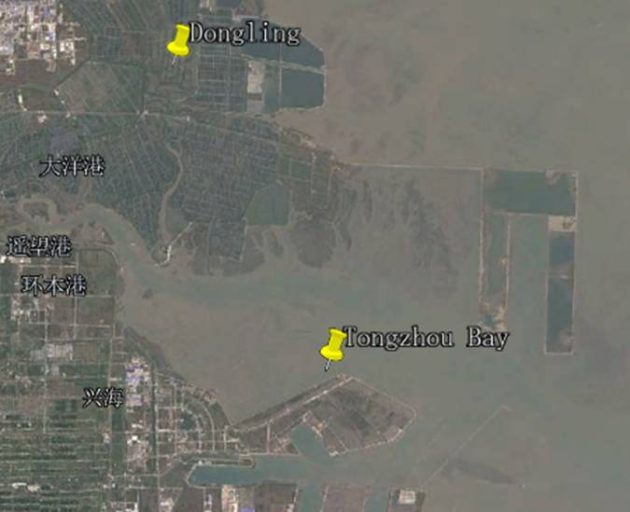
- Food: These coastal towns used to have mainly seafood restaurants for local people and tourists. Due to reclamation, there are many new factories and people from all over China working there. Thus, there are many new restaurants with various kinds of food, even incl. some western fast food such as KFC. Chinese food is usually better, but KFC, etc., can be ordered on your smartphone. So it’s quite good, you can order in advance and go pick it up, and continue birding with a hot burger for lunch. Otherwise, there are almost no restaurants or shops along the seawalls.
Tiaozini is a WH with limited choices of food on the seawall. No cold beer (actually no beer) is served. It’s better if you bring your beer from Jianggang town.
Birds of East Asia: China, Taiwan, Korea, Japan, and Russia (Princeton Field Guides)

Links
- Spotlight: Counting Spoon-billed Sandpipers in Tiaozini, China
- Birding Tiaozini, Jiangsu, China
- Tiaozini wetlands: The successful Chinese coastal restoration case
- Saving the Spoon-billed Sandpiper, one of the world’s rarest wetland birds
By Zhang Lin
Zhang Lin is a bird guide based in Shanghai with extensive knowledge of the Spoon-billed Sandpiper. He has been profiled on 10,000 Birds before and can be reached at Xxx can be reached at zhanglinastro@163.com
Additional Information on Habitat Change around Rudong
Before 2017, there was large-scale reclamation (by building seawalls on the intertidal mudflats) going on almost all along the coast. Smooth Cordgrass was introduced to help reduce the impact of the tides on the seawalls. Trees were planted on the seawalls. Inside the seawalls, agriculture, aquaculture, industries such as chemical plants, ports, etc are developed. Wind turbines are built on the mudflats and along the seawalls. Very recently, solar panels have become the main form of green energy, built either in aquaculture ponds or on the intertidal mudflats.
Compare to see how reclamation goes on around Dongling (from 2008 to 2018).
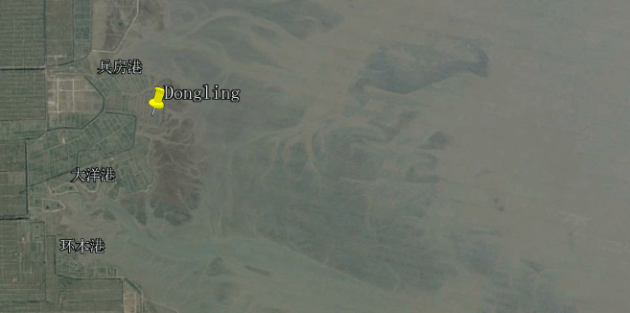
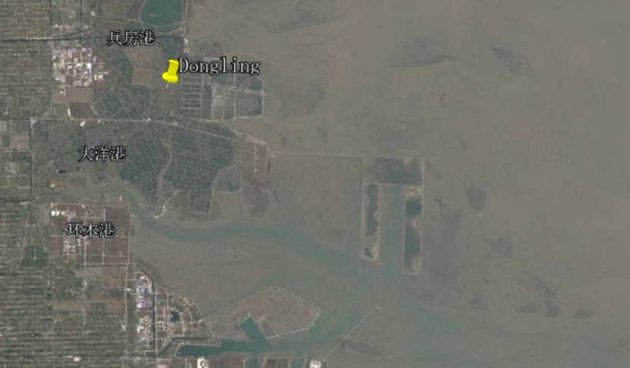
Smooth Cordgrass has been eradicated in most areas due to a national policy.
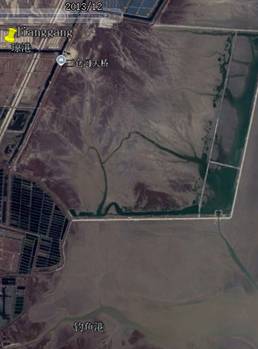
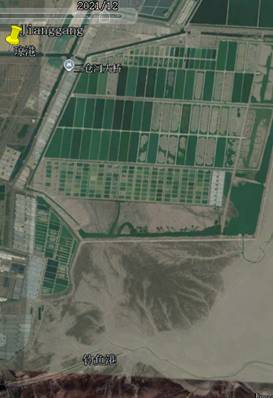
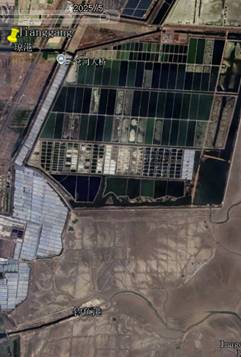
Compare to see how Smooth Cordgrass expands and then is erased around Jianggang (from 2013 to 2021 to 2025). In the image of 2013, the new seawalls surrounded the cordgrass near the old seawalls, while on the still intertidal mudflat outside, there was no cordgrass yet. In the image of 2021, almost the whole of the mudflat south of the new seawall was covered with cordgrass. In the image of 2025, the grids on the mudflat were for drowning the remaining cordgrass roots after cutting.
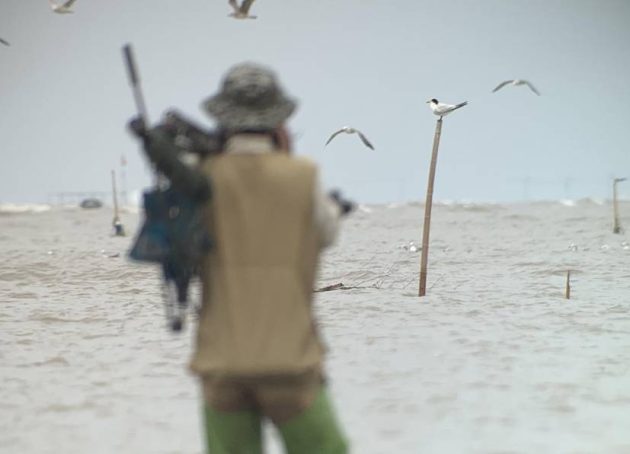
Intertidal mudflat at high tide. The mudflat is inundated, and most migratory birds are near the seawalls. Only certain individuals tend to stay in or above water, including Zhang Lin, watching the second record of a Chinese Crested Tern for the province. The first, second, and almost all records of this tern are from Dongling.





What a great profile – super useful information.