

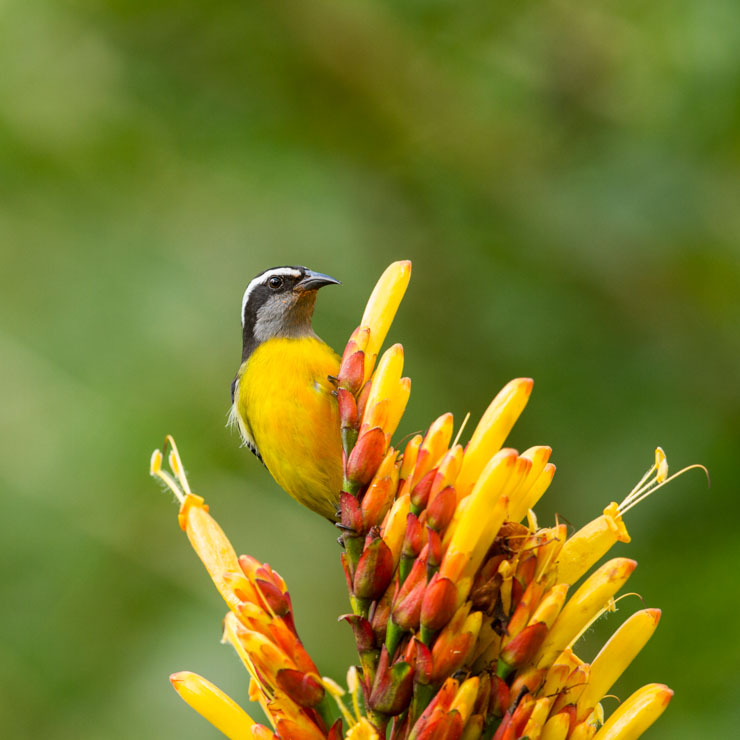
Inspired by Peter’s comment on one of my earlier posts on this blog, I decided to shine a spotlight on the often ignored Bananaquit. The reaction of birders to the presence of a Bananaquit varies greatly, I have found. In the initial stages of a birding tour, these cheerful birds tend to elicit some degree of a positive reaction – this glow usually wanes in the following days for a number of reasons.
Firstly, Bananaquits are noisy. While objectively their sunshiny twittering is cheerful and uplifting, their calls can sometimes obscure the softer and more distant vocalisations of other species. Further to this, some portions of their elaborate songs can be more audible than others, and I’ve had many a birder question the source of a sound that turned out to be a Bananaquit from down the road.
This leads me to my other point, and one of the names I’ve reserved for the ubiquitous Bananaquit over the years: The Bird of False Hope. This is a bird that is similarly sized to a plethora of other species, behaves like several different families, and is usually the first bird spotted in any particular location. Sometimes Bananaquits can be furtive, bouncing around in thickets like spinetails do, other times they are flitting around in the canopy, much like a rare, migratory warbler.
But what does the science say about these little birds? For starters, they’ve confused ornithologists over the years – at various times being placed in the Parulidae family of New World Warblers, Emberizidae of New World Finches, as well as in its own family. In the first edition of Birds of Trinidad & Tobago the Bananaquit was listed as Incertae sedis, Latin for “uncertain placement”. Today, they are hosted along with tanagers, honeycreepers, saltators, seedeaters, and many others in Thraupidae.
The Bananaquit was a notable member of the avian landscape for as long as we have been looking at birds. Indigenous people were accustomed to these black and yellow blobs, evidenced by the Bananaquit‘s scientific name: Coereba flaveola – the first word originates from the Tupí word “guiracoereba” meaning “a blue, black, and yellow nectar-eating, finch-sized bird”, as described by Georg Marcgrave.
Bananaquits are distributed widely across Latin America and the Caribbean, where they are mostly common except in areas of dense forest. They readily adapt to human habitation and are often eager to grab any available sucrose, sometimes attending artificial nectar feeders in great numbers. Some hummingbird aficionados (a curious and suspect subset of birders in my mind) aren’t fond of them for this reason. For me, all birds matter, and all birds are amazing.
Full disclosure, I have seen Bananaquits robbing the nectar from flowers by piercing the base – but then again that’s how flowerpiercers operate. Further to this, I’ve also seen hummingbirds performing this very act! Maybe everyone doesn’t want to be the vehicle for plant reproduction all of the time?
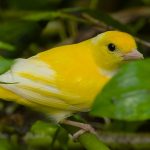
Either way, Bananaquits are incredible little birds – if not at least a little enigmatic – there are no fewer than forty subspecies of these globs of sunshine that annoy some and enchant others. Some differ by size, others by coloration. All are different by voice, as far as I understand. Personally, I haven’t witnessed the full gamut of Bananaquits, but I’ll share a few I’ve crossed paths with over the years here.
This is the standard Bananaquit we get in T&T: black above, yellow below, grey throat, white supercilium.
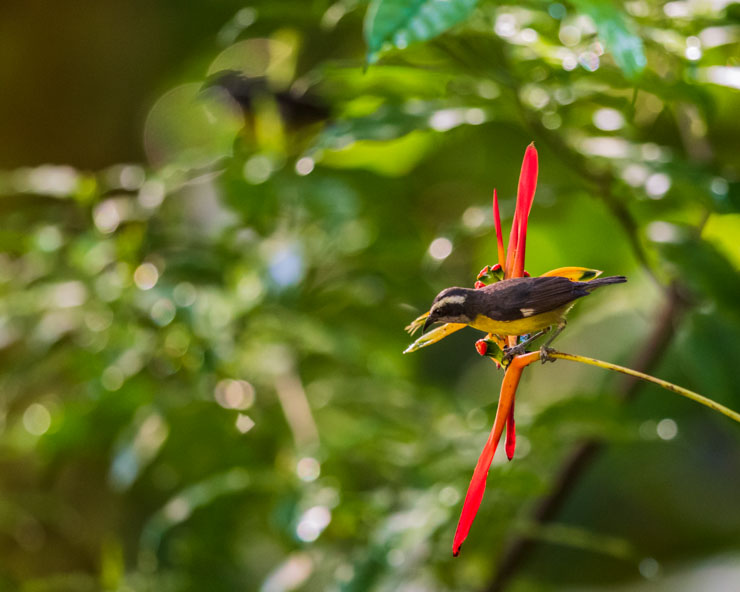
Some Bananaquits are a bit duller, these are typically younger birds.
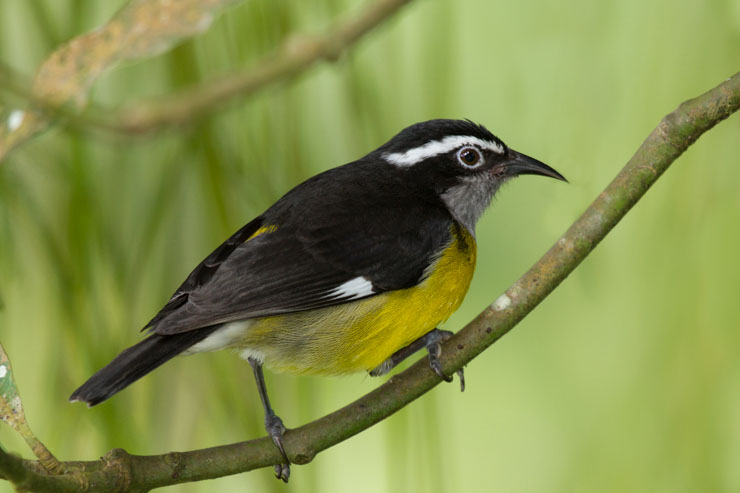
Occasionally some individuals have been seen with a bold eye-ring. I’m not entirely sure what this means, whether it’s a different subspecies or simply individual variation.
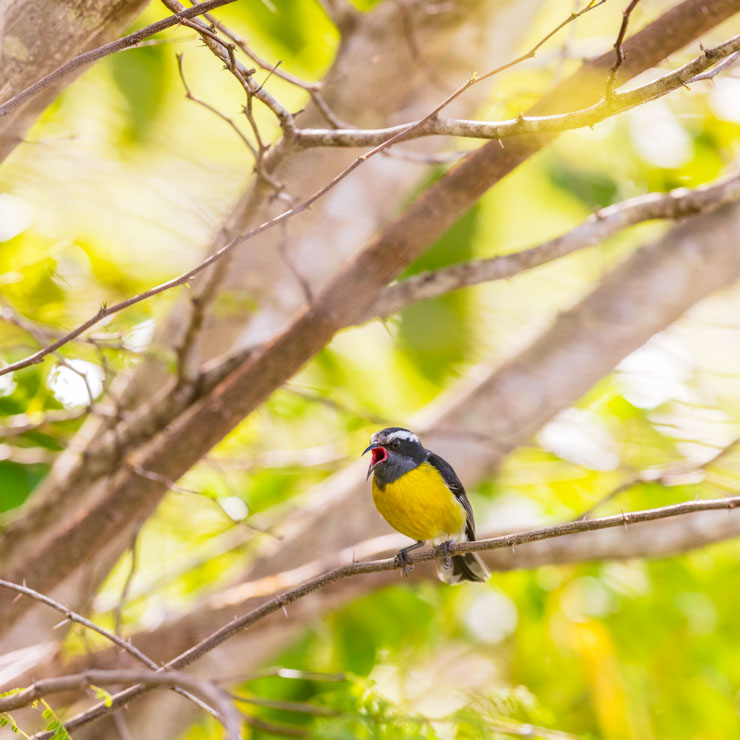
In some other islands in the Caribbean, Bananaquits are a bit more vivid, with a noticeable red gape. This feisty individual was photographed in Barbuda.
Perhaps my favourite of all the Bananaquits is the entirely sooty version found in St Vincent and the Grenadines as well as on Grenada. There are a couple subspecies that share this trait, within which one is polymorphic. If you think this is confusing, try searching for a needle-in-a-haystack Whistling Warbler in a thirty-metre canopy with scores of dark Bananaquits and Lesser Antillean Bullfinches hopping about.
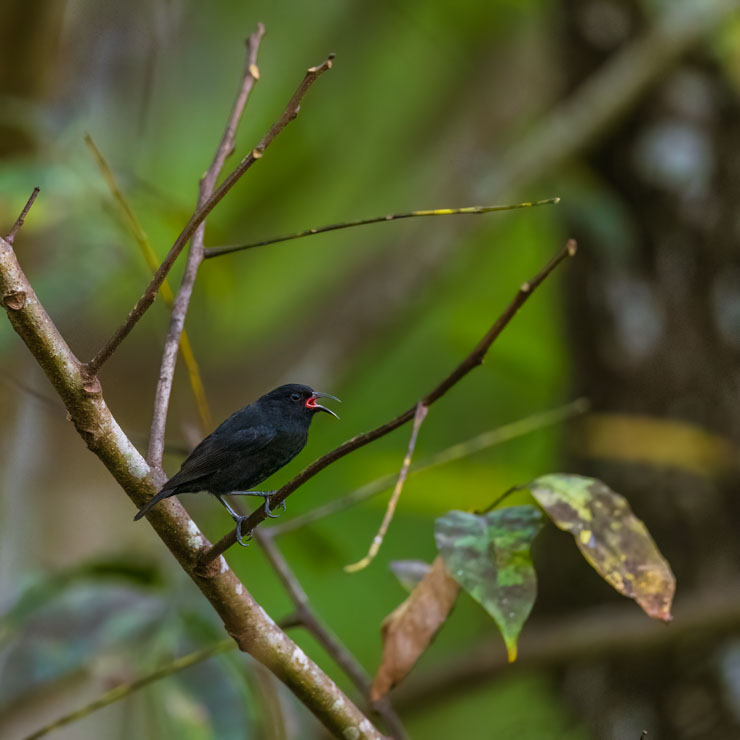
There is a joke about this Bananaquit, but I’ll have to tell you in person. My wife holds the rights to that humorous tidbit – I can, however, assure you it is a joke that delivers each time.
Moreover, the Bananaquit is also the logo bird for regional NGO BirdsCaribbean who is having their silver anniversary conference in Trinidad this coming July. I’m not divulging too many details at this point, but I will be there delivering at least a few talks and messages. Hope to see some of you there!






Leave a Comment