

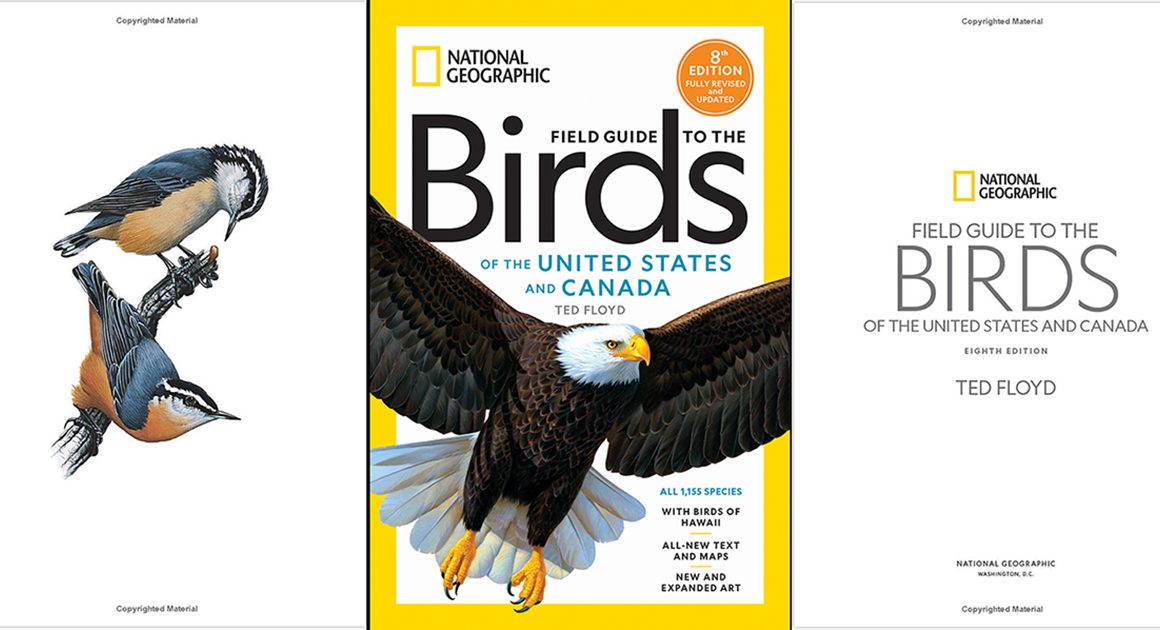
Before writing this review, I arranged my National Geographic birding books on my favorite bookshelf–field guides, pocket guides, encyclopedic guides, birding essentials, birding basics, the titles practically shone in the dark, shiny yellow spines shouting ‘National Geographic’ in customized black sans serif typeface, decades of birding knowledge at the ready. Birds have always been a part of National Geographic’s history and identity. Bird images by George Shiras III, reproduced in 1906, marked the first time wildlife photographs were published in the magazine, pointing it towards its future in photojournalism. Fifty Common Birds of Farm and Orchard, a popular bird identification guide by Henry Henshaw, National Geographic co-founder, published in the June 1913 issue, was a turning point in the magazine’s coverage of educational materials and prefigured the publication 70 years later of the National Geographic Field Guide to the Birds of North America.* Last year, National Geographic published the newest volumes in the field guide series, first the regional guides–National Geographic Field Guide to Birds of the United States and Canada East, Second Edition and National Geographic Field Guide to Birds of the United States and Canada West, Second Edition by Ted Floyd, and then in September, the National Geographic Field Guide to the Birds of the United States and Canada, 8th edition, also by Ted Floyd. A completely rewritten and updated guide, the guide is a striking, noteworthy addition to the NatGeo field guide series and to birders’ lists of must-have identification guides .
Over eight years have passed since the previous title, National Geographic Field Guide to the Birds of North America, 7th edition, and there have been changes. Ted Floyd is the first new author since a team of consultants and editors, headlined by Jon L. Dunn and Eirik A. T. Blum, produced the first edition in 1983.** Ted has rewritten all species descriptions, family descriptions, and added genera descriptions. There is a new, “crowd sourced” method for creating distribution maps, replacing those of Paul Lehman, map guy for editions three through seven. Subspecies maps have been eliminated. Birds of Hawaii have been added, integrated into the text. Additional species added to North American checklists have also been added, and other species eliminated because of taxonomic “lumps,” resulting in total coverage of 1,155 species, 132 more than the seventh edition (this number includes species accounts, rare birds, and extinct birds). The size is larger, the weight, paradoxically, lighter, the font is smaller and lighter. A Bald Eagle still dominates the cover, though in flight rather than repose. And the title has changed. No longer proclaimed as a guide to the birds of North America, the title is now Field Guide to the Birds of the United States and Canada, a change acknowledging the actual geo-political parameters of the guide.
Things that remain the same include visual, textual, and kinetic aids to locating information (thumb tabs, Quick-Find Index, Visual Index to Bird Families, traditional index), much of the artwork, and the structural organization. An Introduction explains how to use the Species Accounts, shows diagrams of bird anatomy, summarizes geographic characteristics of the United States and Canada, explains the range maps, talks about how to bird and the birding community. There are Appendices listing Rare Birds, extinct birds of the continent, extinct birds of Hawaii, and checklist changes; a new five-page Glossary; Illustrations Credits; Acknowledgments; and an Index (mostly of species). Organization of species is still in taxonomic order based on the checklist of the American Ornithological Society, in this edition the 2023 checklist. This is a little disappointing considering the book was published in late 2025 and there were significant changes made in 2024 (lumping of Common and Hoary Redpolls, split of Brown Booby into Brown and Cocos Booby amongst them), but I’m glad the effort was made to include the changes in the fourth Appendix, as well as resources for keeping updated in future years.
ARTWORK
]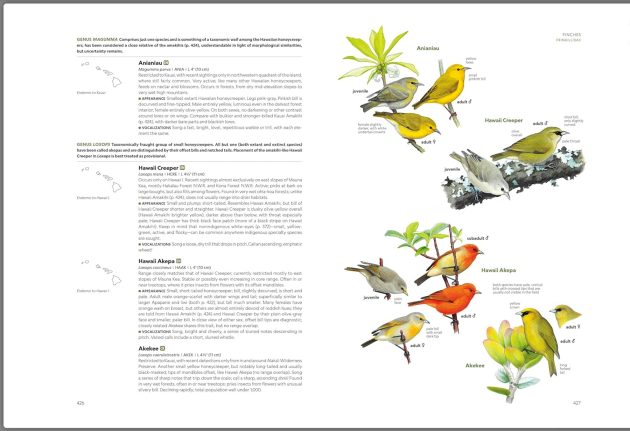
©2025, National Geographic Partners, LLC; pages 426-427, Anianiau, Hawaii Creeper, Hawaii Akepa; text by Ted Floyd, illustrations by Andrew Guttenberg
From the beginning, illustrations for the series have been drawn and painted by multiple artists, updated and expanded over the years, and we now have a group of 21 artists credited in the Illustration Credits. This includes two new young artists, Andrew Guttenberg and Marquette Mutchler, who have added to existing species accounts, created new artwork for the birds of Hawaii (Guttenberg), and worked on the design of each plate. Artists from previous editions are Jonathan Alderfer, David Beadle, Peter Burke, Mark R. Hanson, Cynthia J. House, John Janosik, Donald L. Malick, Killian Mullarney, Michael O’Brien, John P. O’Neill, Kent Pendleton, Diane Pierce, John C. Pitcher, H. Douglas Pratt, David Quinn, Chuck Ripper, N. John Schmitt, Thomas R. Schultz, and Daniel S. Smith. If you have the inclination and eyesight, you can read who created which images in the Illustration Credits, conveniently listed in page order (please enlarge the font and put back the bolding of page numbers in future editions).
The images work best when every illustration on the page is by the same artist (or team of artists). We see that consistency in the Hummingbird family–artwork by Alderfer on his own and Schmitt and Alderfer, with the exception of Sophie Webb’s Lucifer Hummingbirds–and in three genera of Tyrant Flycatchers, including Empidonax, where all species are painted by David Beadle. I think the big question is whether having different artists represented on one illustrated plate interferes with using the guide. I also think we need to consider that a lot of effort has gone into making the overall presentation on each plate consistent in terms of poses, groupings, text labels, and overall design. Consistency in these elements helps the user focus on finding the information needed. The larger size of the eighth edition means there is room for larger illustrations, which gives many of the plates a feeling of visual ease. Text labels and symbols have been tweaked in myriad ways: species names are in color; descriptions of identification features are shortened; some text pointing out features have been eliminated and in other places, descriptions have been added. The overall goal appears to be to un-clutter the plates and make them work with the new text, or, as Floyd says in the Introduction, “efficiency of presentation” (p. 7).
This really is a grand collection of scientific illustrations. Nitpicks could be made (that Green-tailed Towhee is too pale!) and omissions may be pointed out (ducklings? where are the ducklings?), but overall, the guide offers an astounding number of images presented informationally and beautifully. Species are depicted in poses and plumages in which they are likely to be seen–gulls are shown flying and perched, shorebirds are standing, warblers are perched. Age ranges and female plumages are illustrated when they are distinctive enough to be important for identification. We see Short-billed Gull, for example, in 1st winter, 2nd winter, breeding, and juvenile plumages, the first three stages both flying and perched. There are female images of all Wood-Warblers, but no age or female depictions of Swifts. Subspecies, or as Floyd describes them, “groups of closely related yet morphologically distinct individuals from different geographic regions,” are illustrated and labelled with the common name (when there is one, sometimes it’s just “adult Interior West”) and scientific name.
My favorite illustrations depict birds in a bit of habitat–woodpeckers perched on trees (one Acorn Woodpecker even has an acorn in its bill), alcids on a rocky ledge, Western Kingbirds flying over a farm field. In addition to being labeled for age, sex, and subspecies, images are accompanied by brief identification points, sometimes emphasized with additional close-up drawings of that feature–irregularly placed primary tips, an orange lower mandible, red facial skin and eye. Hummingbird descriptions include tail spread close-ups and outlines of primary feathers. There are comparative illustrations–Tyrant Flycatchers on a wire, woodpeckers on top of a snag, flying grebes in winter plumage. There are also some illustrations (and accompanying text descriptions) of hybrids–the expected Lawrence’s Warbler and Brewster’s Warbler (hybrids of Golden-winged and Blue-winged Warblers), and two of the many gull hybrids–Olympic Gull (Glaucous-winged Western) and Chandeleur Gull (Kelp x Herring).
With each edition, the organization of illustrations and the illustrations themselves have been thought out, re-thought out, and improved. Guttenberg, who also functioned as Art Coordinator, talks about the art goals of the new NatGeo series in his ABA interview with Nate Swick. Additions for this volume include more birds in flight, some hybrids, species added to the Rare Birds section, and of course the Hawaiian species. Gutenberg created about 200 images, he says, many aimed at filling in “holes,” such as blackbirds in flight; the trick was to create new art while aligning poses and style with the existing art. His colored pencil drawings for the new Hawaiian species, where he could create without reference to previous artists, show off his talent for combining technical precision with graceful design, intelligent composition, and a clear love of color. He often includes typical plants and flowers, aids to identification not always found in other field guides.
SPECIES ACCOUNTS & DESCRIPTIONS
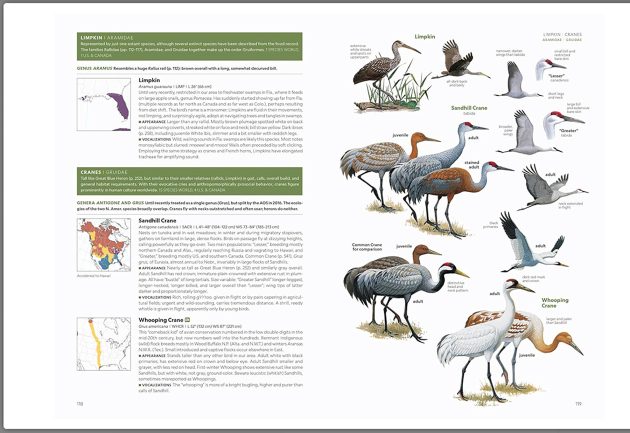
©2025, National Geographic Partners, LLC; pages 118-119, Limpkin and Cranes.
Ted Floyd has totally rewritten the text for this guide (and the two regional guides), from Introduction through Species Accounts through Appendices. Think about it. Full descriptions of the 911 species in the Species Accounts plus bird families and genera; brief descriptions of the 199 species in the Rare Birds Appendix; longer write-ups for the 40 species in the appendix on Continental Extinctions (and a summary for Hawaiian Extinctions); plus a species-by-species summary of Recent Checklist Updates. That’s a lot of writing about birds! Floyd does it masterfully. He comes to NatGeo Guide field guide authorship by way of a career engaged in ornithological writing, editorship, and education. With an academic background in ecology and evolutionary biology (B.A., Princeton, 1990) and ecology (Ph.D., Penn State University, 1995), Floyd became editor of the American Birding Association’s Birding magazine in mid-2002 and is still editing it today (with co-editor Frank Izaguirre). He is a regular participant in the ABA Podcast with his “Random Birds” series and has taught biology, math, statistics, and various birding courses, and spoken at birding festivals and conferences around the world. His books include two previous field guides, the Smithsonian Field Guide to the Birds of North America (2008, available from Scott & Nix) and the ABA Field Guide to Birds of Colorado (Scott & Nix, 2014, updated in 2025), plus his book of bird identification essays, How to Know the Birds (National Geographic, 2019); he has also written numerous journal articles, technical papers, popular magazine articles, and book chapters. He is also a colleague and friend.
Species Accounts are comprised of 707 long accounts of more widespread and common species and 204 short accounts of species that are highly localized or regionally rare. The longer descriptions follow a formula laid out in the Introduction: (a) the big picture, giving a general “feel for the overall natural history of the species”: geography and habitat, behavior, brief notes on subspecies; (b) appearance–size, shape, details of color and pattern, geographic variation when needed for identification; (c) vocalization–song, calls, nonvocal communications like drumming–both descriptions and transliterations. The big picture descriptions are, in my opinion, a prime reason for using this guide. They are detailed yet compact, specific to the bird itself while giving environmental context, sensitive to common identification problems birders may have without condescension, fact-based while consistently well-written in essay-quality prose. Here, for example, is the description for Sandhill Crane:
Nests on tundra and in wet meadows in winter and during migratory stopovers, gathers on farmland in large, dense flocks. Birds on passage fly at dizzying heights, calling powerfully as they go over. Two main populations: “Lesser,” breeding mostly northern Canada and Alas., regularly reaching Russia and vagrating to Hawaii; and “Greater,” breeding mostly U.S. and southern Canada. Common Crane (p. 541), Grus grus, of Eurasia, almost annual to Nebr., invariably in large flocks of Sandhills. (p. 118)
Amazingly, this description is different from Floyd’s descriptions in the companion regional volumes. Here is the beginning of the entry in NatGeo West:
Nearly as tall as Great Blue Heron (p. 206) and similarly gray overall, often stained with rust. Cranes fly with necks outstretched and often soar; herons do neither. Adult Sandhill has red crown; immature plain-crowned with extensive rust in plumage. All have “bustle” of long tertials. Size variable. “Greater Sandhill” longer-legged, longer-necked, and larger overall than “Lesser”; wing tips of latter darker and proportionately longer. (p. 100).
And here is the first part of the Sandhill Crane description in NatGeo East:
Few sounds in nature are more stirring than the proclamations of cranes migrating overhead. The late winter gathering of this species along the Platte R. in Nebr. is widely acknowledged to be one of the grandest spectacles in the continent. (p. 96).
Some of the text descriptions are reminiscent of National Geographic’s first bird guide publication, Fifty Common Birds of Farm and Orchard. Here is American Robin, for example, as described in NatGeo * :
The robin is so familiar that it is easy to take the species for granted. But, it is one of our greatest birds, with extraordinary migrations, an incredible song, and endlessly fascinating feeding and breeding behaviors. Found anywhere, from remote wilderness to our largest cities: Hunts worms on lawns, gorges on berries in fruiting trees, nests on homes and other structures… (p. 402).
And here is American Robin as described by Henshaw in 1906:
In the North and some parts of the West the robin is among the most cherished of our native birds. Should it ever become rare where no common, its joyous summer song and familiar presence will be sadly missed in many a homestead. The robin is an omnivorous feeder, and its food includes many orders of insects, with no very pronounced preference for any. I is very fond of earthworms, but its real economic status is determined by the vegetable food….The principal item is fruit…. (the rest of the description is concerned with alternatives to killing robins before they eat all the fruit in the orchard, thankfully not a 21st-century concern).
Floyd is very conscious that the purpose of the Species Accounts is to help users identify a bird, and his descriptions incorporate specific diagnostic features, usually also pointed out in the illustrated plate opposite. He notes how to differentiate similar looking birds in the Appearance section. This section, which can be rather technical in other guides, is very readable, relying on basic avian anatomical terms which are shown in the introductory section on Parts of a Bird and defined in the back-of-the-book Glossary. His experience working with birders on identification shows through. For White-rumped Sandpiper, he warns “beware that any fast-flying sandpiper can catch bright glare as it twists and turns” (p. 142); birders hoping they have a Bicknell’s Thrush are warned to make sure the warmer tail they’re observing does not belong to “just” a Hermit Thrush.
RANGE MAPS
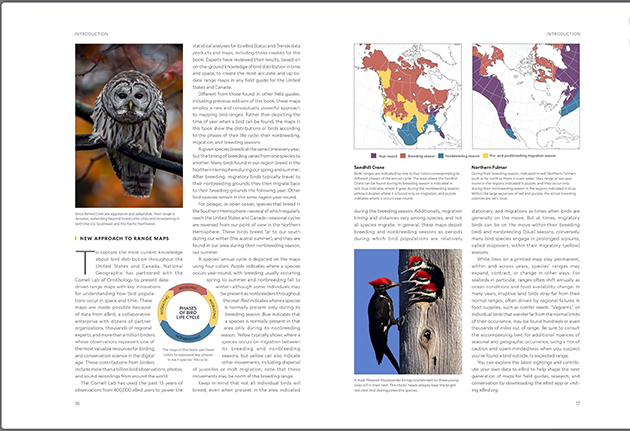 ©2025, National Geographic Partners, LLC; pages 16-17, Introduction: New Approach to Range Maps
A huge change from previous editions are the range maps. Sourced from eBird, as part of a partnership between National Geographic and the Cornell Lab of Ornithology, the maps show life cycles rather than typical seasonal distribution. Floyd goes into detail about the construction and meaning of these maps in the Introduction, emphasizing the fluctuating diversity of birds’ life cycles and movements. How different is this from the 7th edition range maps, developed by Paul Lehman? Those maps also showed (1) “breeding range, generally in spring and summer” in a dull reddish shade, (2) year-round range in purple/blue, (3) winter range in light blue, (4) spring/autumn migration range in dark yellow, (5) primarily spring range in light green, and (6) primarily autumn migration range in bright yellow. Under the new system, we have four colors to decipher: (1) breeding season in dull red, (2) year-round in purple, (3) nonbreeding season in blue, and (4) pre- and postbreeding migration season in yellow.
Comparing maps across 7th and 8th editions, I was surprised to see that most had similar color blocks and outlines, but not so surprising because most of our birds do breed in spring and summer, do not breed in winter, and migrate in spring and fall. You can see range changes over the intervening years if you look closely, a little difficult since the maps in both volumes are small and other sources should be consulted for detailed changes (eBird itself would the best source). Still, I could see the slight move northward for Carolina Chickadee, the expansion of Fish Crow into the interior states, and the contracting breeding range of Nelson’s Sparrow. Some nuance has been lost with the absence of those primary spring and primary autumn ranges, especially in the sparrow maps. Range maps for the Hawaiian Islands are uncolored outlines of the islands with notes below indicating on which island(s) the species can be found. Additional information is found in the Populations section.
CONCLUSION
Can we have too many field guides? I don’t think so, and in a publishing world where companies are being bought out and discontinuing long-standing imprints and looking towards digital publication of everything, I’m thrilled that National Geographic, a company that itself has been sold and merged and reduced in size over recent years, is still publishing birding field guides. National Geographic Field Guide to the Birds of the United States and Canada, 8th edition by Ted Floyd continues the comprehensive scope of previous editions and takes the unprecedented step of presenting completely new text, reflecting the latest research and field observations. Artwork and design has been expanded and tweaked and most importantly, two young artists have been brought into the NatGeo fold. The guide continues to be easy to use–you can use the Quick-Find Index on the inside front flap to locate bird families if you know the name of the family, the Visual Index of Bird Families on the inside front and back covers to locate families if you’re not sure of the name, the Index to locate species by common or scientific name, and my favorite user aid, the thumb tabs, to quickly flip to your favorite families–Sandpipers, Gulls, Hawks, Flycatchers, Thrushes, Sparrows, or Warblers. My main criticism is the lighter, smaller font, making it difficult to read in the field. Please, National Geographic, have empathy for those of us with older eyes and use a darker font in future printings.
The 8th edition of the National Geographic Field Guide to the Birds of the United States and Canada aims to “succinctly convey the essentials for accurate identification for all bird species occurring in the United States and Canada” (p. 7), a statement that I think undersells the riches it contains. This is a guide that I think birders of all skills levels will use easily, effectively, and joyously.
* The Feather Wars by James H. McCommons, St. Martin’s Press, 2026 & Henry Henshaw: The National Geographic Founder Who Helped Save America’s Birds by Mark Collins Jenkins, October 25, 2012. https://web.archive.org/web/20121105053956/http://newswatch.nationalgeographic.com/2012/10/25/henry-henshaw-the-national-geographic-founder-who-helped-save-americas-birds/
** Various people worked on earlier editions, as “consultants” and “staff editors.” Jonathan Alderfer became co-consultant and art coordinator (and a major art contributor) starting with the third edition, and the team of Dunn and Alderfer have been considered authors and editors through the 7th edition, though they were not credited on the title page till the fifth edition.
National Geographic Guide to Birds of United States and Canada, 8th ed.
by Ted Floyd
National Geographic, distributed by Penguin Random House, September 2025
592 pages; illus.; 6.06 x 1.02 x 8.99 inches; 13 ounces
ISBN-10 : 1426223080; ISBN-13 : 978-1426223082
$32.00 (discounted from the usual suspects)






Leave a Comment